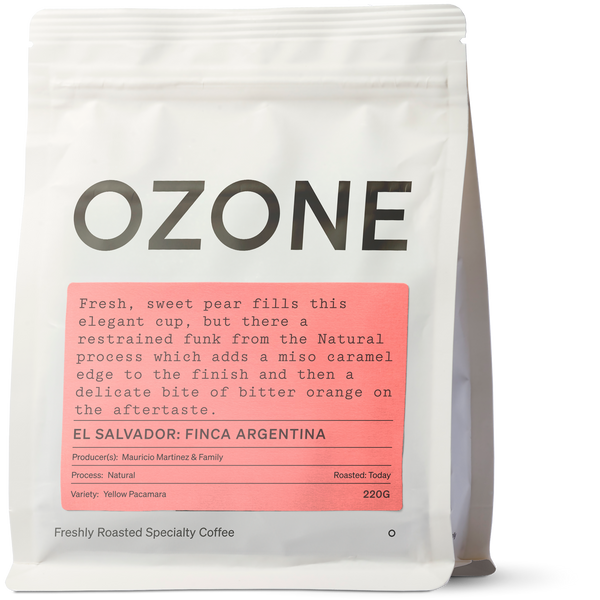
Some farms come to you through trade shows or sample submissions. Others arrive wrapped in a story you couldn't make up if you tried. Finca Argentina is firmly in the second camp.
A Farm Reborn
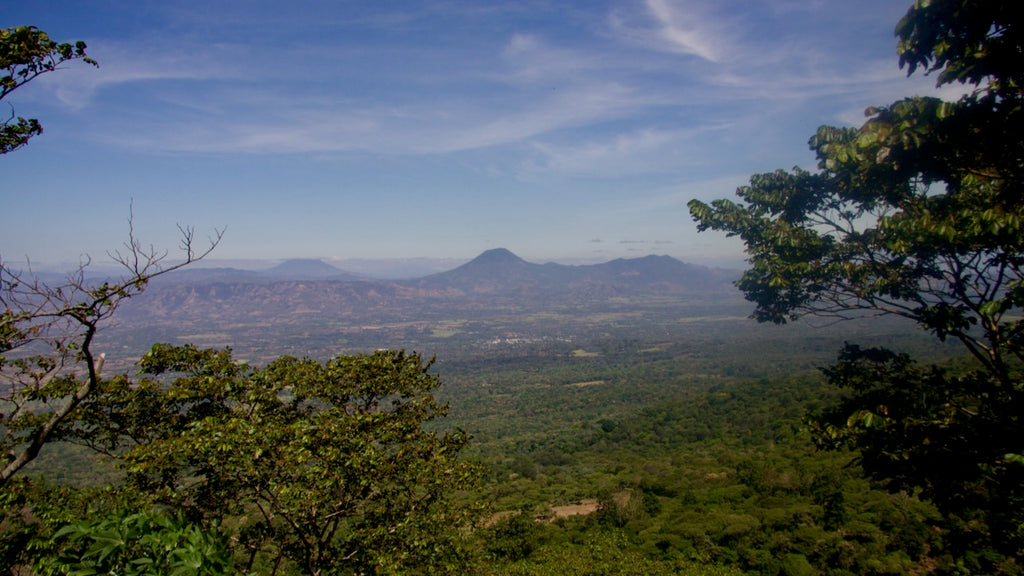
Nestled in the Apaneca-Ilamatepec mountain range – El Salvador's largest coffee-growing region and a UNESCO-recognised biosphere reserve – Finca Argentina sits near the town of Turin in the Ahuachapán department. The 35-hectare estate faces north, with clear views across to the Guatemalan border and the El Espino valley below. Volcanic vents bubble nearby, a constant reminder of the geothermal forces that have shaped this land and enriched its soils over millennia.
The farm was acquired in 1967 by Luis Guillermo Martinez, a doctor by profession, and quickly became his favourite among several coffee estates. For decades it produced well. But by the time his son Mauricio inherited the property in 2008, yields had dropped to a fraction of what they once were. Mauricio, unsure what to do with the farms, was considering his options when his son Alejandro stepped in.
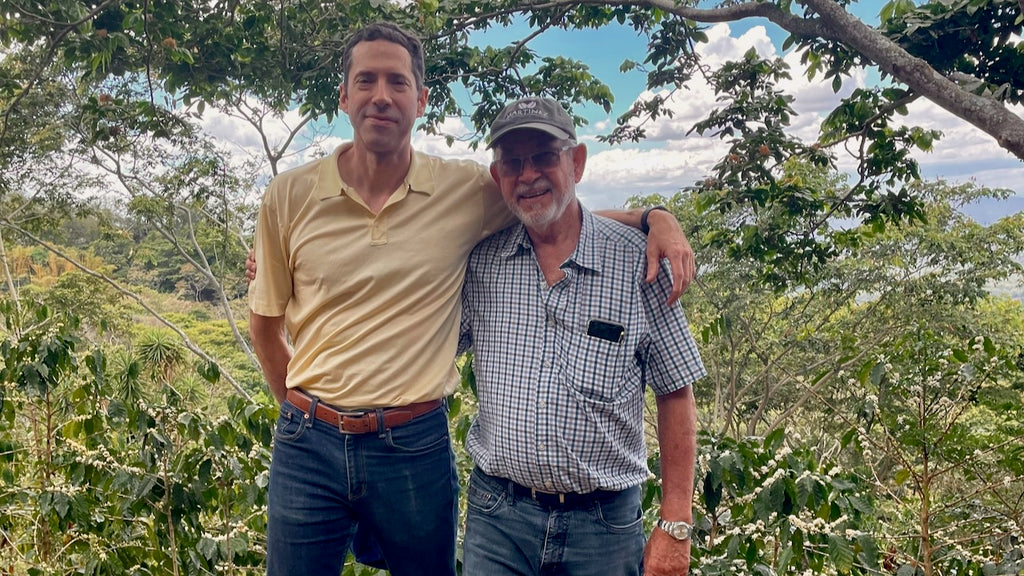
Alé had just relocated back to El Salvador from New York, where he'd been working as a VP of Investment Banking at Bank of America Securities. With his son Lukas on the way and the hustle of Manhattan no longer appealing, the pull of home was too strong to ignore. While looking for work and helping his father manage various business interests, Alé became curious about this underperforming farm called Finca Argentina.
Digging through old records, he discovered the coffee had been classified for a Q auction back in 2005 – a sign that quality was there, just waiting to be unlocked. Convinced there might be a specialty buyer somewhere willing to take a chance, Alé and his London-based cousin began sending samples to roasters across Europe. One of those samples landed with us in Stafford. We liked the coffee. And the rest, as they say, is history.
Seventeen Years and Counting
We've been buying from Finca Argentina since 2008, and in that time we've watched the farm transform. What started as a professional relationship has grown into something much deeper – Alé has become a close friend, appearing in Steve Leighton's book Coffeeography: The Coffee Producers and joining Steve on speaking tours to share the realities of coffee farming with audiences around the world.
The family setup has evolved over the years. Mauricio, now in Canada following Alejandro who moved there some time ago, still owns the farm and oversees operations remotely. He visits El Salvador regularly to check in, but day-to-day decisions are handled by a trusted farm manager and the team on site. Mauricio's daughter Beatrix, who hadn't previously been involved in coffee, is now stepping in to help with the family business – the next generation learning the ropes.
The Land
Finca Argentina ranges from 1,150 to 1,350 metres above sea level and receives around 2,700mm of rainfall annually. Average daily temperatures sit at a comfortable 23°C, with the north-facing aspect providing shelter from the stronger winds that can affect exposed slopes.
The farm is divided into seven distinct tablones – individual plots shaped by the landscape, each with its own character:
- San Jorge is the highest section, sitting between 1,300 and 1,360 masl. At just 2 hectares, it was replanted with Yellow Pacamara several years ago.
- Fincona 2 is the workhorse – 8 hectares of the farm's most productive land, between 1,250 and 1,300 masl.
- Fincona 1 covers 4 hectares at 1,200–1,250 masl. The coffee here is intercropped with macadamia nut trees, planted in 2020.
- Guachipelin spans 6 hectares and was replanted in 2016 with H1 (Centroamericano), Yellow Bourbon, Icatu, and a small amount of SL-28.
- Los Mangos, also 6 hectares, is home to a volcanic vent with areas of boiling mud – the slightly different soil composition here seems to have a subtle but noticeable impact on the coffee, which tends to score higher in blind tastings than Bourbon from other sections of the farm.
- Piletas sits at the lowest elevation (1,150–1,200 masl) and covers 6 hectares.
- 4 Manzanas is a 3-hectare plot replanted in 2018 with Portillo, a Bourbon hybrid.
In 2023, the farm added Mundo Novo to the mix – a Bourbon × Typica variety with commercial importance in Brazil but rarely seen in Central America. The first harvest from these trees is expected in 2026.
Volcanic Terroir
The Apaneca-Ilamatepec mountain range accounts for around 60% of El Salvador's coffee production, thanks to its fertile volcanic soils and favourable climate. The name "Apaneca" comes from Nahuatl and translates roughly as "place of water and winds" or "river of winds" – fitting for a landscape shaped by eruption and erosion.
Nearby, the Los Ausoles geothermal field covers some 20 square kilometres and contains over 130 active features: mud pots, fumaroles, and steam vents, including the Santa Teresa ausol – the largest geothermal vent in Central America, measuring 70 metres wide and 20 metres deep. The dry mill that processes Finca Argentina's coffee takes its name from this extraordinary landscape.
In 2005, the Santa Ana volcano (also known as Ilamatepec) erupted and blanketed the region in ash. For many farms, production was shut down for up to two years. But the volcanic matter that fell rejuvenated soils with minerals and nutrients, and the region's coffees have flourished since. It's a reminder that this is very much a living, breathing landscape – one that demands respect but rewards those who work with it.
On the Ground
Throughout the growing season, individual workers at Finca Argentina are given significant responsibility over pruning and managing trees. On many farms, pruning is regimented – every other tree gets a skeleton prune in a given section, for example. Here, those decisions are left to the knowledge of the staff, who assess each plant individually as they work through an area. It's easy to ruin coffee production with the wrong pruning choices, so this approach shows real trust – and is only possible when you retain and develop your workers' skills over the long term.
Labour shortages have become a real concern across Central America, with many people from coffee-growing regions migrating to cities or to the United States in search of better opportunities. In recent years, El Salvador's overall safety has improved with reduced gang activity, but farms still have to work hard to retain staff during the critical harvest months.
The Martinez family employ 50 people during harvest and 30 the rest of the year. They contribute labour and materials to improve infrastructure in surrounding towns, and grow 25 kg of corn annually for each worker. They're also implementing more ecological management practices: using compost and other organic products to minimise environmental impact, and intercropping beans to enrich the soil. The results speak for themselves – improved biodiversity, better cup quality, and a farm with a bright future.
Processing
All washed processing is carried out at the Los Ausoles dry mill, a cooperative facility in Ahuachapán that has a strong relationship with Mauricio and has shown good consistency and reliability for us as buyers. Natural lots are processed on-site at the farm.
Challenges and Outlook
This year's growing season has brought mixed fortunes. Overall volume is good, but anomalies in local weather are causing flowering to spread over a longer period than usual. This means more of this season's crop is likely to be lost to underdeveloped or dried-out cherries by the time harvest arrives.
The main issue affecting plant stock at Finca Argentina this year is Anthracnose, a fungal disease that causes die-back of leaves and branch tips. The team are treating it through careful pruning and fungicide application – another reminder of the constant vigilance that coffee farming demands.
Despite these challenges, the future for Finca Argentina looks bright. The Martinez family's commitment to experimentation – trialling varietals like Centroamericano H1, Icatu, Obata, and now Mundo Novo – combined with their investment in people and practices, means we're excited to see what the next seventeen years will bring.
Farm Information
- Country: El Salvador
- Region: Apaneca-Ilamatepec
- Department: Ahuachapán
- Municipality: Ahuachapán
- Nearest town: Turin
- Farm: Finca Argentina
- Producers: The Martinez Family
- Farm size: 35 hectares
- Elevation: 1,150–1,350 masl
- Average temperature: 23°C
- Annual rainfall: 2,700mm
- Dry mill: Los Ausoles
- GPS: 13°56'29.4"N 89°47'04.1"W