

How to Recycle Our Packaging
Everything we send you can be recycled or reused. Here's how.
Coffee Bags
Where: Soft plastics collection points at supermarkets – Tesco, Sainsbury's, Co-op, Morrisons, M&S, Aldi, Iceland, Lidl, and Waitrose all have them.
How: Empty out any remaining coffee, give the bag a shake, and drop it off next time you're shopping. No need to remove the labels – they're recyclable too. These go in the same bin as your bread bags and crisp packets.
Find your nearest collection point →
Important: Please don't put coffee bags in your household kerbside recycling – soft plastics need specialist processing that kerbside collections can't currently provide.
Or Send Them Back to Us
If you'd prefer, you're welcome to post your empty bags back to us and we'll take care of recycling them. Just bundle them up and send to:
Ozone Recycling
Unit 16, Ladford Covert
Ladfordfields Industrial Estate
Stafford
ST18 9QL
Please make sure the correct postage is applied, as unfortunately we're unable to accept or collect underpaid items.
Kraft Paper Mailers
Where: Your paper and cardboard recycling at home.
How: Flatten and pop in with your cardboard. Done.
Cardboard Boxes
Where: Your paper and cardboard recycling at home.
How: Flatten and recycle. All the tape we use is paper-based, so there's no need to remove it first.
Shredded Paper Void-Fill
What it is: The scrunched-up paper keeping your orders safe in transit is actually shredded cardboard from deliveries we've received ourselves. We run it through our cardboard shredder at the roastery – affectionately named Shredder, after the Teenage Mutant Ninja Turtles villain – giving it a second life before it heads to recycling.
Where: Your paper and cardboard recycling at home, or add it to your compost.
Bubble Wrap (Occasional)
What it is: We occasionally reuse bubble wrap and other protective packaging that arrives with our own supplier deliveries. Rather than bin it, we pass it on.
Where: Reuse it yourself if you can – or take it to a soft plastics collection point at your local supermarket.
For Wholesale Customers
If you're generating larger volumes of soft plastics, you can arrange commercial collections through services like First Mile or Refactory.

Why We Chose Recyclable Packaging
Here's the thing: we used to use compostable coffee bags. We believed in them. But the more we learned, the more we realised they weren't working as intended – and we had to change course.
Compostable packaging sounds perfect in theory. In practice, it needs industrial composting facilities running at 50–60°C to break down properly. The UK has just 24 large-scale facilities that accept compostable packaging – and most councils explicitly reject it from food waste collections because their processing systems can't handle it. That means most compostable bags end up in landfill or incineration, where they behave much like conventional plastic.
A 2022 UCL study called The Big Compost Experiment put this to the test. Researchers worked with over 1,600 households to track what actually happens to compostable packaging in real-world conditions. The results were stark: 60% of products certified as "home compostable" didn't fully break down, even after months in active compost heaps. The study concluded that home composting simply isn't an effective way to process these materials in the UK.
We also found our compostable bags weren't keeping coffee as fresh as we'd like. Coffee is sensitive stuff – oxygen is the enemy, and even small increases in exposure accelerate staling. Compostable materials achieve around 70% of the barrier performance of conventional packaging, and for a product where freshness is everything, that gap matters.
So we made the switch to recyclable bags made from post-consumer recycled plastic – and we're confident it's the better choice.
What Our Coffee Bags Are Made Of
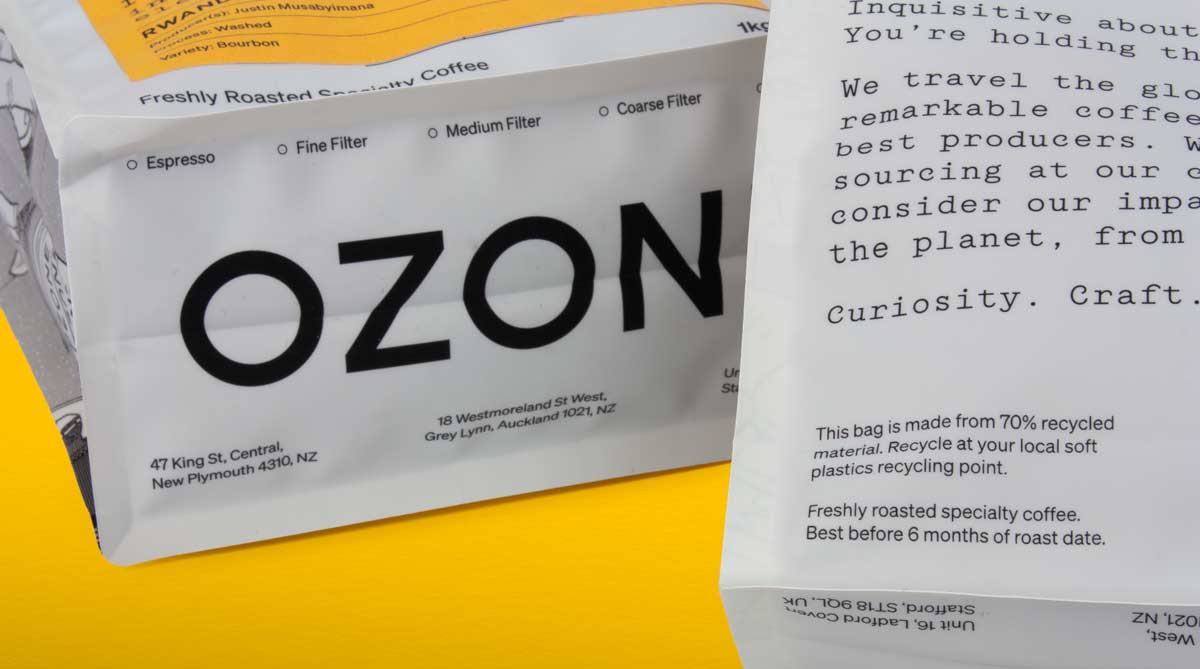
Our bags are made from Grounded Packaging's Wastemade material – a mono-material PE film containing 70% post-consumer recycled content. That's plastic that's already had a previous life as bags and packaging films, now given another go.
Using recycled content cuts the carbon footprint roughly in half compared to virgin plastic – independent lifecycle assessments put the reduction anywhere from 40% to 70% depending on the methodology. And because it's a mono-material (one type of plastic throughout), the whole bag can be recycled together without needing to separate layers. That's important: traditional multi-layer flexible packaging – the kind with different plastics laminated together – has a recycling rate of around 5%. Mono-materials are designed for the recycling systems we actually have.
The bags go into the soft plastics stream at supermarket collection points. There are now more than 4,000 stores across the UK accepting soft plastics. The infrastructure isn't perfect – a significant portion of collected material currently goes to energy recovery rather than being recycled into new products – but it's improving rapidly, and collection is the essential first step.
From March 2027, kerbside soft plastics collection becomes mandatory across England, which will make recycling these bags as easy as putting out your cardboard. Wales is following a similar timeline, and Scotland is already ahead – Fife Council became the first in the UK to offer kerbside soft plastics collection, supported by a dedicated processing facility handling 15,000 tonnes annually.
The Bigger Picture
We're a certified B Corp, which means we're committed to continuous improvement – not perfection. When we first adopted compostable packaging, recycled food-grade materials weren't a viable option. Now they are, and the infrastructure to recycle them is growing. We'd rather work with a system that actually functions than champion an ideal that doesn't deliver.
This isn't about abandoning our values. It's about following the evidence and making choices that genuinely reduce environmental impact. Recycled plastic keeps materials circulating in the economy, reduces demand for virgin resources, and enters a collection stream that's expanding year on year.
We're not alone in this shift. Many specialty roasters are reaching the same conclusion as the science becomes clearer and the infrastructure improves. It's a pragmatic choice – one that prioritises real-world outcomes over good intentions.
If you'd like to read more about our packaging journey, we wrote about the change here.