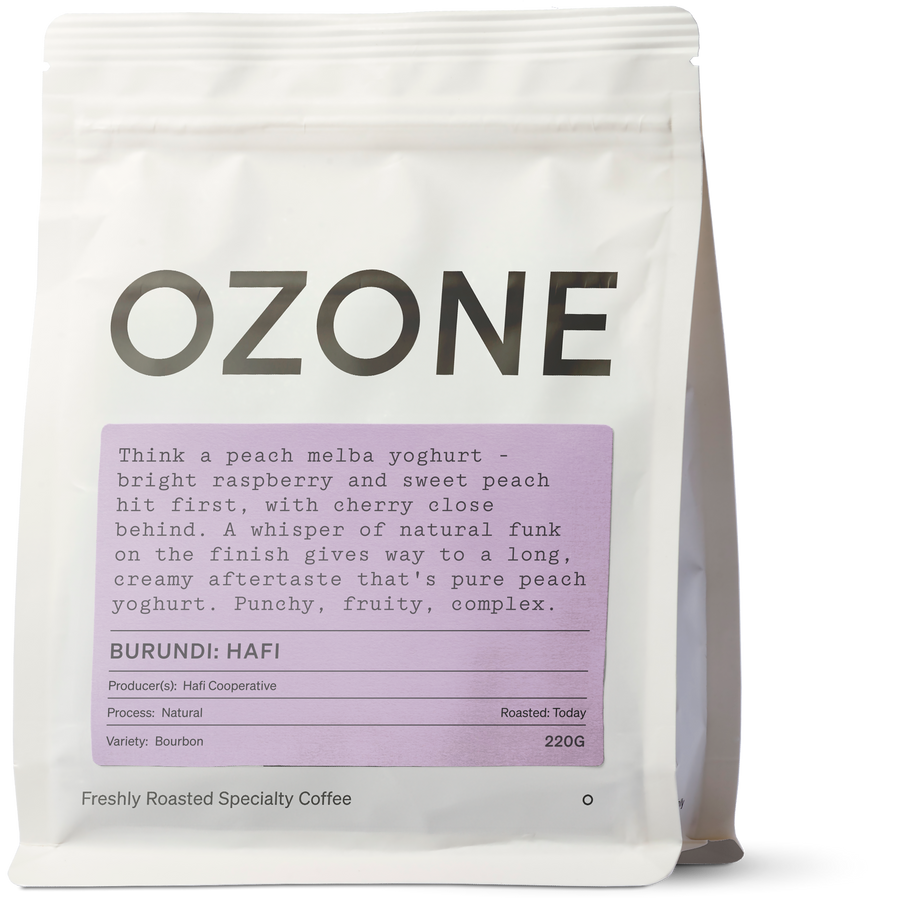
There's a specific kind of coffee moment we live for. The one where the first sip lands, you pause, and the only appropriate response is to take another. This new Burundi from the Hafi Cooperative is firmly in that category. A natural-processed heirloom Bourbon that tastes like pudding and somehow manages to feel bright and refreshing at the same time.
Think peach melba yoghurt. Bright raspberry and sweet peach arrive first, with cherry close behind. There's a whisper of natural funk on the finish, and then a long, creamy aftertaste that's pure peach yoghurt. Punchy, fruity, properly complex. If you've been waiting for a reason to break out the V60, consider this it.
When logistics become a craft
Here's the thing that makes this coffee's story so compelling. The Hafi farmers didn't choose natural processing because it was fashionable. They chose it because it was the only option.
The cooperative is tucked into the hills of Muyinga Province in Burundi's remote northeastern corner. It's a six-hour drive from Bujumbura if the roads haven't washed out, and until fairly recently, the nearest wet mill was over a day's journey away. Too far to haul freshly picked cherries and still expect anything worth drinking at the other end. Washed processing, which is the dominant method across the rest of Burundi, simply wasn't on the table.
So the farmers adapted. They started drying their coffee whole on raised African beds, and over time they developed their own anaerobic fermentation techniques, sealing the cherries in low-oxygen conditions for controlled periods before drying. What started as a workaround became a craft. And then the craft became a reputation. Today, Hafi's naturals are sought after by specialty roasters around the world, and the cooperative has doubled its number of drying beds to keep up with demand.
The name Hafi means "near" in Kirundi. It was chosen by the farmers themselves, a quiet statement of aspiration for the processing infrastructure they didn't yet have close to home. That aspiration has taken on new meaning over the years. Closeness to market. Closeness to opportunity. Closeness to recognition for work done exceptionally well.

Meet the cooperative
Hafi is made up of around 2,000 smallholder farmers, many of them women, working tiny plots of land in Muyinga's rolling volcanic hills at around 1,715 metres above sea level. The average farmer here might tend a couple of hundred trees and produce less than a pallet of speciality-grade coffee in a good year. Too little to attract a buyer independently, which is exactly why the cooperative model matters. It aggregates micro-lots into exportable volumes while keeping traceability and quality intact.
Many of the trees themselves are decades old. Legacy Bourbon plantings from the colonial era, with deep root systems shaped by the specific volcanic soils and cool mountain air of this particular patch of hillside. Muyinga isn't as well-known as Kayanza or Ngozi to the west, but it's quietly earning a reputation for fruit-forward intensity and a chocolatey depth that sets it apart. If you want the fuller picture on the cooperative, our dedicated Hafi producer story goes deeper on the region, the farmers, and the landscape.
Jeanine Niyonzima-Aroian and JNP Coffee
Hafi's coffee reaches the global market through JNP Coffee, an exporter founded in 2012 by Jeanine Niyonzima-Aroian. Her story is worth telling properly.
Jeanine grew up in Bujumbura, where her mother's stories of the family cultivating coffee in Ngozi Province to pay for school fees left a lasting mark. It was coffee, essentially, that funded her education. After earning an MBA from Northwestern University's Kellogg School of Management, she spent more than two decades in international business, but Burundi never quite let her go. She'd been working with rural coffee-farming women through her non-profit Burundi Friends International when she tasted what Burundian speciality could really be at a Cup of Excellence competition. That was the moment. JNP Coffee followed shortly after.
Today, Jeanine is a licensed Q Grader, a certified Q Processor, and sits on the SCA Board of Directors. JNP works with over 18,000 farmers across Burundi. By any measure, she's one of the most influential figures in Burundian coffee, and a tireless advocate for the country's producers on the global stage.

The Dushimé® programme
At the heart of JNP's model is a programme called Dushimé®, which means "let's be thankful" in Kirundi. It's a beautifully simple idea with genuine impact.
After JNP sells each harvest to roasters and buyers around the world, they go back to the farming communities with a second payment. Not a bonus, not charity. A quality premium, typically between 20 and 40 cents per pound, that directly reflects the price the coffee achieved on the international market. It's a real, tangible link between what a roaster in London pays and what the farmer in Muyinga receives.
To date, Dushimé disbursements have passed the half-million-dollar mark. More than 10,000 women and their families have benefited. The programme also funds financial literacy education and leadership training, which is where the longer-term transformation really happens. When Jeanine visits the cooperatives to distribute the second payment, the farmers dance and sing. She joins in. It's a small detail that tells you almost everything about the relationship.
A quick note on Bourbon in Burundi
Bourbon is the dominant arabica variety in Burundi, but here's where it gets interesting for the coffee-curious. What's labelled "Bourbon" in this country is actually a family of related heirloom cultivars, including Jackson, Mbirizi, and Kent, all of them old Bourbon relatives introduced during different waves of colonial planting. The trees are often decades old, the plots are small, and the farmers understandably don't dig up productive trees just to identify their exact genetic strain. So the catchall label sticks.
What matters is what ends up in the cup. Old-growth Bourbon, planted in volcanic soil at altitude, is one of the great combinations in coffee. It delivers the sweetness, body, and fruit complexity that Burundi is increasingly celebrated for. If you want to go deeper on the variety's history and why it matters, our varietal guide to Bourbon covers it all.

How we're roasting it
Naturals always ask you to walk a line, and this one's no different. Push it too light and you let the fermentation character run unchecked. All funk, no finesse. Take it too far the other way and you flatten the acidity that gives the coffee its energy.
The sweet spot is a fairly quick roast with enough development to bring out Bourbon's inherent creaminess and body, while keeping things moving briskly enough that the bright, fruity top notes stay intact. The natural processing has already done a lot of the heavy lifting on complexity. The roast just needs to stay out of its way and let the coffee speak for itself. Our team cupped it at 89 points using Cup of Excellence methodology, and if you want to understand what that actually means, we've written a piece on how cupping scores work.
Why this coffee matters
We love a coffee with a story, but we love one with a story and a cup to back it up even more. Hafi has both. It's a coffee born from constraint, shaped by resourceful farmers, exported by a woman-led business reinvesting profits directly into the communities that grew it, and finished with a natural process that turns heirloom Bourbon into something that tastes, improbably, like peach melba.
Burundi remains one of speciality coffee's most underexplored origins, and the farmers at Hafi are a big part of why that's starting to change. We're proud to be part of the story.