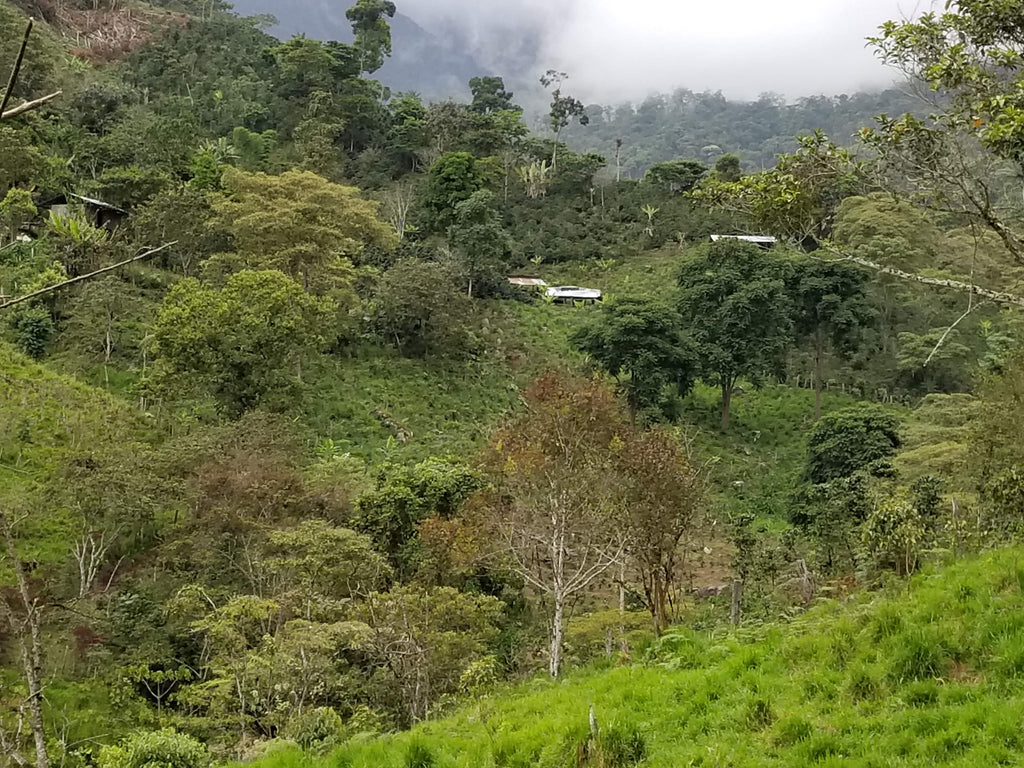
Getting to Einer Saldivar's farm is not a simple undertaking. Flights into Jaén only resumed in October 2025, after more than two years of runway closure, and before that the nearest working airport was an eight-hour drive away. Jaén is the easy part. From there it's another hour and a half by car to the local receiving village, thirty more minutes to Einer's house, then a steep forty-five-minute climb on foot up a hillside to find him at El Cedro. Most of his picked cherry makes that last descent by donkey.
At 2,050 metres above sea level, in the cool, mist-prone mountains of Colasay district, Einer has what quality demands: extreme altitude, traditional varieties, and a hectare he knows tree by tree. Nearly all his neighbours are cousins or distant family. He inherited the farm from his parents.
Colasay, a region coming into its own
Colasay is a district south-west of the city of Jaén, in Jaén province, in the Cajamarca department of northern Peru. It's one of a handful of micro-regions that Origin Coffee Lab started exploring in 2017, sampling coffees from remote districts west and south-west of Jaén that had rarely, if ever, been on the specialty radar.
Today Colasay is one of OCL's most closely watched sourcing areas. Around 80 to 90% of the district's production is a single Bourbon variety, and the cool, often chilly climate allows a slower dry after harvest. Access is still difficult, particularly during the rainy season when the roads become impassable. The isolation that kept Colasay off the map is part of what preserved it.
The Bourbon de Colasay variety
The local Bourbon that Einer grows has an unusual story. In the field, the trees bear an uncanny resemblance to traditional Bourbon, and producers have always called it that. Genetic testing says otherwise. Bourbon de Colasay more closely resembles Catimor genetics, though it doesn't match any known Catimor variety exactly. It looks like the result of a natural cross-pollination or mutation that happened in this area some years ago and then quietly took hold.
Catimor-type varieties are usually prized for disease resistance and productivity, and marked down for vegetal, astringent cups. Bourbon de Colasay carries the practical advantages, more fruit per tree and strong resistance to coffee leaf rust, without the usual penalty. For producers facing a warming climate and a spreading rust problem, that combination is worth watching.
El Cedro, and how we found Einer
El Cedro covers around one hectare, planted with 200 trees of the local Bourbon and 1,000 trees of Catuai. The farm has a small beneficio, or wet mill, with a mechanical pulper and fermentation tank where Einer processes his own coffee. Everything about it is small scale, and Einer has had the problems that come with that: limited access to buyers, limited agronomic support, and, until recently, equipment that put quality at risk.
Roland and Paul first came across his coffee in a cupping session in 2022 and visited soon after. Einer had already been asking questions and looking for ways to improve. His old depulper and fermentation tank had become the weak point in an otherwise promising set-up. When he asked for our help, it fitted Ozone's sustainability project, which invests in infrastructure that changes producer livelihoods rather than in one-off gestures. We helped finance a new depulper and fermentation tank. The improvement was immediate.
Einer is now renovating part of the farm to trial new planting systems. The lot stays small. That's what one hectare at this altitude, at this remoteness, produces.
Origin Coffee Lab
Origin Coffee Lab runs the receiving station in Einer's local village, which is what makes the rest of it possible. OCL is an exporter based in Jaén, founded by Alex Julca and José Rivera, both Peruvians with long careers in the country's coffee trade. Alex was head cupper at Peru's largest cooperative before setting up on his own.
Their Solidario programme provides ongoing training in farm management, post-harvest technique and quality assessment, and producers cup their own lots so they can see where the coffee sits and what would move it. Without OCL we wouldn't have heard of Einer, and he wouldn't have the agronomic guidance or the market access. We work with them elsewhere in Cajamarca too, including with Nima Juarez at El Roble.
Traceability
- Country: Peru
- Department: Cajamarca
- Province: Jaén
- District: Colasay
- Village: Bomboca
- Producer: Einer Saldivar
- Farm: El Cedro
- Farm size: ~1 hectare
- Elevation: 2,050 m.a.s.l.
- Varietals: Bourbon de Colasay, Catuai
- Process: Washed
- Certifications: Organic
- Exporter: Origin Coffee Lab (Solidario programme)
- Relationship since: 2022