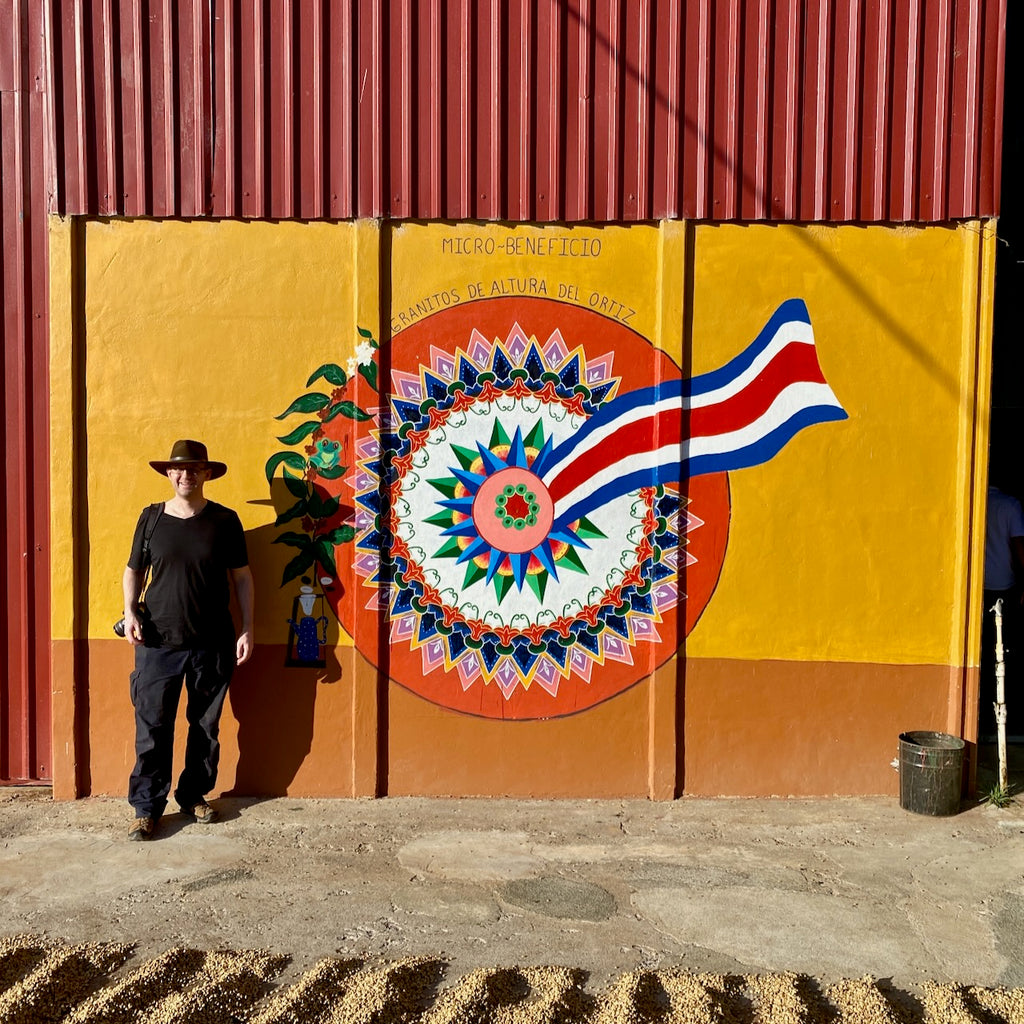
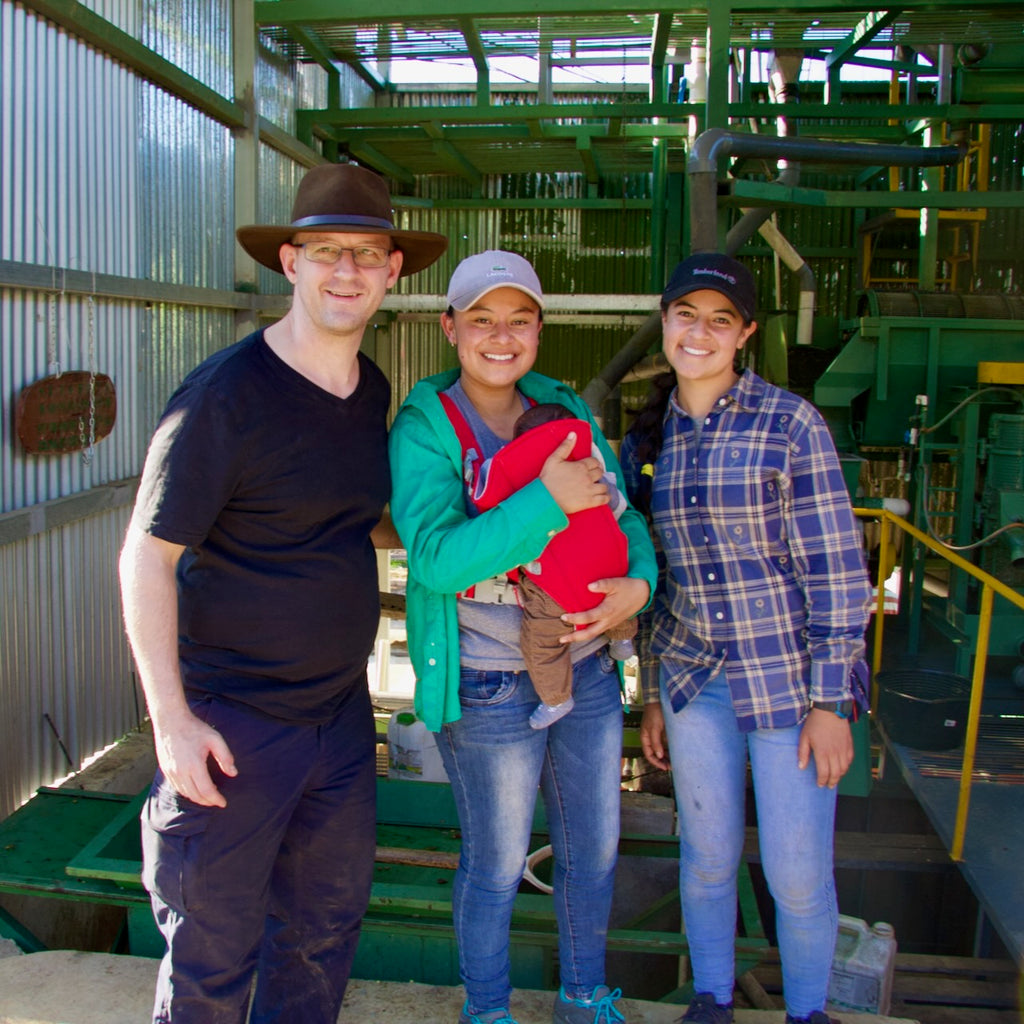
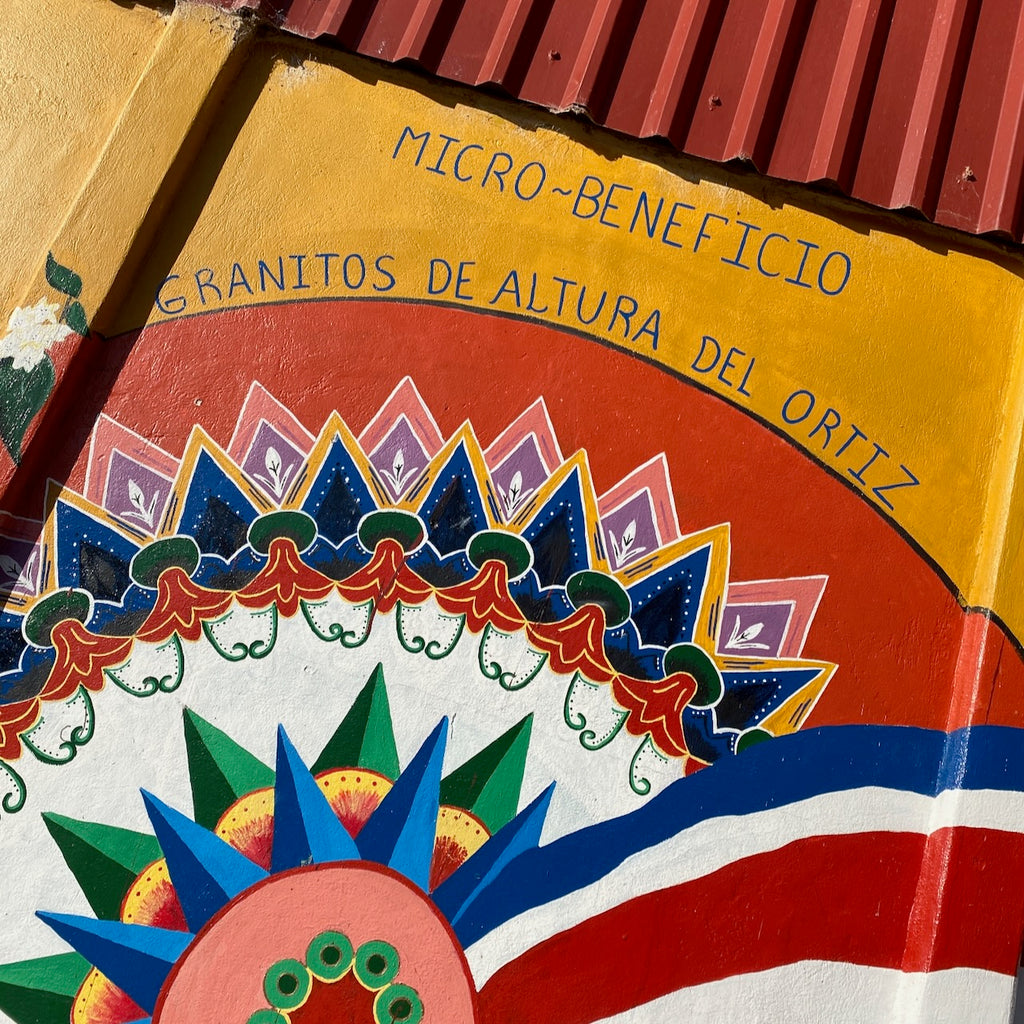
In the heart of Santa María de Dota, a picturesque town in Costa Rica's famed Tarrazú region, lies Micro-Beneficio Granitos de Altura del Ortiz, a family-run micromill producing some of the most elegant and expressive coffees in Central America. Run by sisters Johana and Joyce Calderón, this small but mighty operation is a shining example of Costa Rica's micromill revolution.
How we found them
In 2015, our Green Buyer Roland Glew sat on the international jury for the Costa Rica Cup of Excellence. Cup of Excellence is judged blind. Nobody in the room knows whose coffee is in front of them, only what's in the cup, and the names are read out once the scores are locked in.
Tenth place that year, with 88.44 points, went to a lot from Finca Ortiz 1900 in Santa María de Dota. The name on the entry was Johana Calderón Martínez.
That was the first any of us had heard of Granitos de Altura del Ortiz, and it was more than enough. Wanting a coffee and being able to buy it are two different things, though, and it took until 2022 before the first bags finally made their way to us through our long-standing export partners, Exclusive Coffees. We've bought from the family every year since, and we have no intention of letting the connection slip again.
The mountains of Tarrazú
The Tarrazú region, in the San José province, is one of the most celebrated coffee-growing areas in the world. It's made up of the Dota, San Marcos and León Cortés cantons, threaded through by the mountains of the Talamanca Sierra.
The conditions here are about as good as coffee growing gets. Fertile volcanic soils, an average temperature just under 20°C, and steep slopes that deliver two things at once: the altitude for slow cherry maturation, and shelter for the trees. Tarrazú coffees are prized for their bright acidity, floral aromatics and clean, sweet profiles, and the reasons are all written into the landscape.
The family's farms sit across that spread of altitude, from around 1,700 to 2,100 metres above sea level. That range is deliberate and it matters. Cherries at the top take their time to ripen, concentrating sugars and building the complexity and clarity that define the cup.
High altitude little beans
The name "Granitos de Altura" translates to "High Altitude Little Beans", a nod to both the terroir and the meticulous care that defines the family's approach.
The mill was built by the sisters' father, Omar Calderón, a man with decades of coffee growing behind him and a long-held ambition to process his own harvest rather than hand it over to a cooperative. That decision put the family firmly in the middle of Costa Rica's micromill movement, where growers took control of their own processing so that a good lot could be tasted, named and sold as itself, with the value staying where it was created.
Omar still oversees that side of things today, managing each of the farms that feed the mill. Rather than a single estate, Granitos draws on a scatter of family plots at different points up the mountainside, each one simply named for the elevation it sits at: Ortiz 1800, Ortiz 1900 and Ortiz 2000, alongside Nery, Bisunga and La Esperanza. It's a practical naming system for a very deliberate approach, since it lets the family match what's growing to where it grows best, and separate out lots by altitude when a particular harvest calls for it.
Then Johana and Joyce asked whether they might take the reins at the mill itself. He said yes, of course he did. That was just over a decade ago.
Women in coffee: Johana and Joyce Calderón
The sisters have run the mill together ever since, with Johana leading for much of that time. There was a recent spell when she stepped back to welcome a new baby and Joyce took the lead solo, and it's a measure of how the two of them work that the transition barely registered in the coffee. Johana is now back, and the two of them are once again running the mill side by side. Omar still plays a vital role, managing the farms where the coffee is grown.
What they're not doing is getting bigger. Johana and Joyce are deeply committed to quality over quantity. Rather than expanding production, they focus on refining every step they can control, from cherry selection through to drying, so that each lot meets their exacting standards. Choosing to make less coffee better is a harder commercial decision than it sounds, and they've stuck to it.
Their philosophy is rooted in connection: with the land, with the coffee, and with the people who come to visit and share in the experience.
"When the harvest is in full swing, the days are long and the workloads are heavy," Joyce says. "But we're energised by people visiting, sharing their time, and connecting over coffee."
Dos Semillas
The sisters have started a side project they're calling Dos Semillas, or "Two Seeds". They buy cherry from other local farms and process it themselves at their own mill, running it alongside the main Granitos work with the aim of building up enough funds to eventually buy a farm of their own.
Every farm in the Granitos operation to date has been Omar's. This would be the first piece of land Johana and Joyce own outright, bought with money they've earned themselves. Omar has been entirely supportive, and has already donated Geisha seeds for them to plant there once they buy.
Trialling something new
The sisters have also been working with Omar to plant new varietals on the existing farms. They're not expanding the estate, just putting small plantings in alongside the established stock: Milenio, Starameyer, Catigua and Paraíso.
These are newer varietals with a growing reputation for cup quality, and Granitos isn't alone in taking a look. On his last visit Roland noticed Starameyer and Milenio cropping up on a number of other farms in the area, with several producers trialling small volumes to see how they perform in the field and on the cupping table. Only time will tell which of them earn a permanent place, but the willingness to experiment on a farm this size, without betting the harvest on it, tells you plenty about how the family thinks.
Investing in a quiet year
Roland's most recent visit to Granitos was in 2024. Costa Rica had seen a couple of relatively low harvests, and by the time he arrived in May the picking was already finished, earlier than usual and with less coffee brought in than the family would have liked.
What happened next is the part worth paying attention to. At Granitos, as at a number of farms we work with, those spare days went into improving the farm and the mill. That's a genuinely positive sign. It tells you the operation earns enough in a normal year that a difficult one doesn't force everything else to stop.
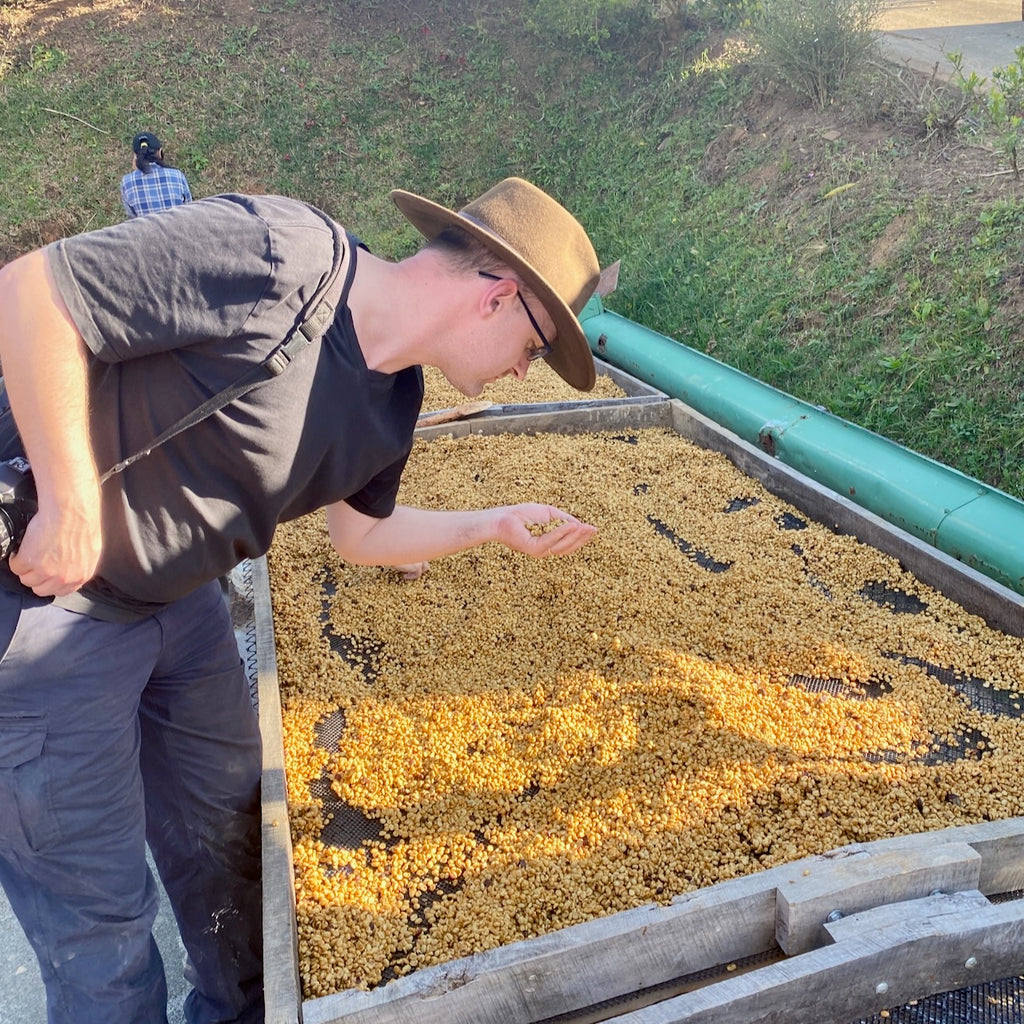
The results were new drying tables and a colour sorter. The extra drying capacity gives Johana and Joyce real freedom to choose whichever processing method they believe suits the coffee in front of them, rather than whichever one there happens to be space for. That's a quality decision dressed up as a logistics one. The colour sorter uses an electronic eye to spot damaged beans and separate them out before batches go on to Exclusive Coffees.
Honey processing, done properly
The coffees we love most from Granitos tend to be the honeys, and they've stood out on our cupping table year after year.
Honey processing sits between washed and natural. A specially calibrated depulper removes the skin of the cherry while leaving the sticky, sugar-rich mucilage intact on the seed, which then stays on throughout drying on raised beds. The mucilage is loaded with sugars, pectin and organic acids, and as the coffee dries two things happen at once: those sugars migrate into the bean, building body and sweetness, while the yeasts and bacteria living on the surface ferment them into acids and esters that shape the flavour.
The interesting part is that honey isn't a single method, it's a dial. Leave more mucilage on and dry more slowly and both effects intensify, taking you towards natural territory. Take more off and dry faster and you land closer to a washed cup. Producers label the results by colour, named for how dark the beans go as they dry:
- White honey: roughly 10 to 20% mucilage retained, 6 to 8 days drying. Clean, crisp, light bodied.
- Yellow honey: roughly 25 to 50%, 8 to 10 days. Balanced, with a rounded sweetness.
- Gold honey: roughly 50 to 75%, 10 to 12 days. Richer and more syrupy.
- Red honey: roughly 75 to 90%, 12 to 15 days. Fruity and winey, medium bodied.
- Black honey: 90 to 100%, 15 to 20 days or more. Intense, jammy, full bodied.
These categories aren't strictly standardised, and what one producer calls a yellow honey another might label gold. The colour names are a useful guide rather than a precise specification, which is exactly why those extra drying tables matter so much. Space on the beds means the sisters can commit to a target and manage the drying properly, turning the coffee often enough to keep it even without rushing the fermentation or letting it clump.
Read our guide to honey and pulped natural processing →
Catuai at altitude
The variety we see most often from Granitos is Catuai, a hybrid of Mundo Novo and Caturra developed in Brazil in the 1940s. It's compact and resilient, which makes it well suited to the steep slopes of Tarrazú, and it has become one of the most widely cultivated varieties in Costa Rica.
Catuai's reputation is for dependability, but push it up past 1,800 metres and something else happens. Slow cherry development at altitude produces denser beans and a good deal more acidity and nuance than its usual billing suggests. In careful micromill hands like these, it's a genuinely expressive coffee.
Catuai is far from the only thing growing here. Across the farms you'll also find Caturra, Villa Sarchí, Typica Mejorado, Geisha, SL28 and Ethiopian landrace varieties, planted alongside the newer trial material. For an operation this size, deliberately staying small, that's a remarkable amount of range to keep on top of.
Read our full guide to the Catuai varietal →
A commitment to sustainability and community
Like many Costa Rican micromills, Granitos de Altura is part of a broader movement towards traceability, sustainability and producer empowerment. By managing their own processing and working directly with buyers, the Calderón family ensures that more value stays in the community.
Their work also reflects a growing trend of women-led coffee businesses in Latin America, a shift that's bringing fresh perspectives and a renewed focus on quality and transparency. Dos Semillas takes that a step further, moving the sisters from running the family's mill towards owning land in their own right.
We source this coffee through our long-standing export partner Exclusive Coffees, who play a huge role in helping us maintain relationships across Costa Rica and get the coffee moving. The Calderón family's commitment to quality and transparency is clear in every lot that arrives.
Why we're proud to work with Granitos de Altura
We're honoured to source coffee from Johana and Joyce Calderón. It took seven years from that first blind cupping in 2015 to getting our hands on any of their coffee, and everything we've tasted since has justified the wait.
Their dedication to quality, their respect for tradition and their passion for people all shine through in every cup. Granitos de Altura del Ortiz is a micromill with heart, and we're proud to share their story and their coffee with you.