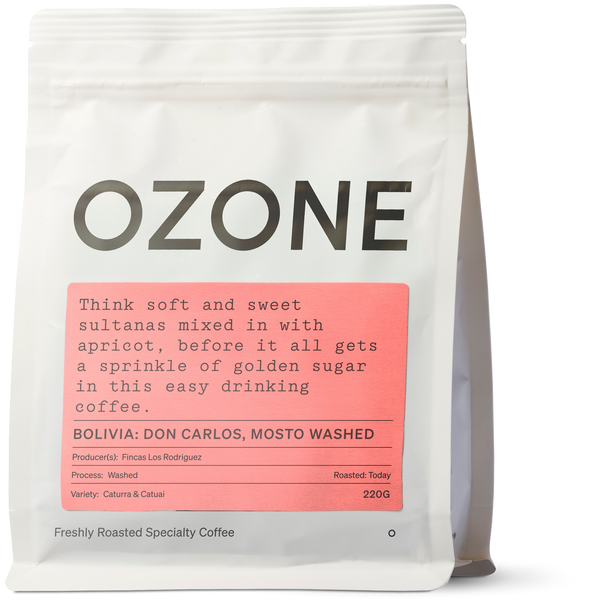
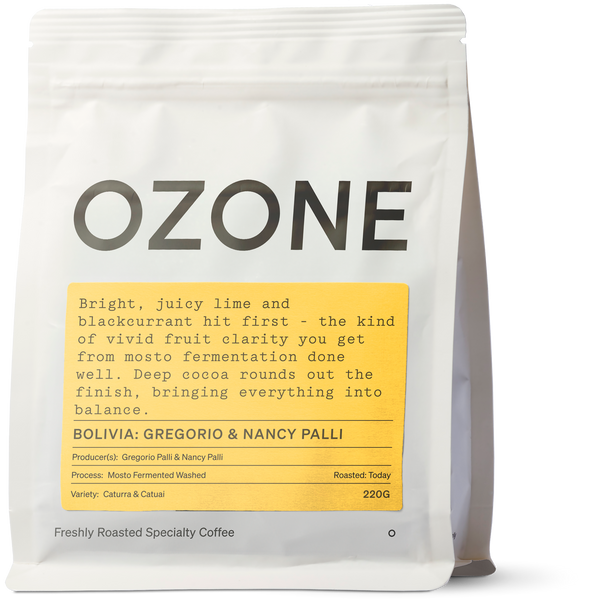
Many of our coffee mates have undoubtedly already heard of the Rodriguez family. If you haven't, suffice to say they've been amazing long-time friends of ours who make everything we get from Bolivia possible. The family owns La Llama alongside eleven other farms in Bolivia, and they run the Sol de la Mañana programme in collaboration with small-scale local farmers. They're not just producing exceptional coffee – they're actively working to save Bolivian specialty coffee from extinction.
The Story Behind the Name
This plantation had already been producing coffee for fifteen years when the Agricafé team first went to view the land. While looking around the farm they were planning to buy, they came across a llama. In their words:
'...we encountered a llama that with its pointy ears, alert look and proud stance seemed to be saying "come near my land and I'll spit on you."'
And so the farm got its name. The llama holds special significance in Bolivia – it's the country's national animal, symbolising endurance, strength, and perseverance. These qualities have been associated with the Andean people for thousands of years, with llamas domesticated some 4,000-5,000 years ago by pre-Columbian civilisations. Agricafe's company mascot Sophia was born from this deep connection Bolivians have with their national animal.
Before it was called La Llama, the farm was known as Puerto de Cuelo. When the Rodriguez family took over, they had a vision: to renovate and remodel the farm to prove it's possible to create a new, thriving coffee plantation on older coffee-growing land. Their intention is to demonstrate what's achievable and hopefully inspire others to follow their lead – renovating ageing coffee-growing areas while generating sustainable income for families living in the region.
The Rodriguez Family & Agricafe
Pedro Rodriguez entered the coffee industry in 1986, ditching his suit and accounting job to pursue his passion for agriculture. What started as a modest venture has grown into Agricafe – now the leading producer of specialty, single origin, and microlot coffees in Bolivia. Today, Pedro runs the business alongside his daughter Daniela (who handles marketing and communications) and his son Pedro Pablo (who manages producer training and logistics). The trio are dedicated to restoring and elevating Bolivian coffee, and they're admirably relentless in this pursuit.
The family's approach to coffee production is extremely methodical, innovative, and scientific. They've consulted leading specialty coffee agronomists from around the world to help them produce exceptional coffee and build sustainable, healthy farms. A wide range of varieties have been trialled, alongside different farming techniques, to optimise quality and output. They've carefully documented their findings at every step, continuing to innovate and invest in improvements.
Today, Agricafe owns twelve farms and around 130 hectares of coffee under the banner of 'Fincas Los Rodriguez'. Eight of these farms are in Caranavi in the La Paz department, with the remaining four in Samaipata in Santa Cruz. The family also operates the Buena Vista wet mill in Caranavi and the La Luna dry mill in La Paz – a state-of-the-art facility sitting at a staggering 3,800 metres above sea level, making it one of the highest dry mills in the world.
Why Bolivian Coffee Needs Saving
Here's the thing about Bolivian coffee: it's been in crisis for decades. While the country has near-perfect conditions for producing exceptional Arabica – high altitudes, nutrient-rich volcanic soils, and ideal microclimates – production has been in freefall. In 2010, exports sat around 70,000 bags. By 2020, that number had plummeted to just 22,000 bags. To put this in perspective, that's equivalent to the annual output of a single large farm in Brazil.
Several factors have driven this decline. The leaf rust epidemic (roya) that swept through Latin America from 2008 onwards devastated small farms across the region, with Bolivia hit particularly hard. Some farmers switched to coca – grown for the drug trade and illegal to produce in Caranavi – because it provided a high year-round income. For those who stayed in coffee, yields declined due to ageing plantations, unsophisticated farming practices, and a lack of government support. Unlike Colombia or Guatemala, Bolivia lacks a strong centralised body to promote and support coffee production.
In 2012, as leaf rust started to obliterate production in many small farms, Pedro and his family began investing in their own plantations, fearing coffee production in Bolivia would disappear completely. They recognised this was critical to guarantee a minimum level of supply and ensure their business's future sustainability. Their first farm, Finca La Linda, became the starting point of a much larger vision.
Sol de la Mañana: A School for Producers
In 2014, fifteen local producers approached Pedro Pablo and asked for help. The Rodriguez family saw this as both a responsibility and an opportunity: if they didn't take action, Bolivian coffee culture would slowly disappear. Thus was born Sol de la Mañana (Morning Sun) – the first producer mentoring programme of its kind in the country.
When the programme began, the average producer was yielding just 2.5 bags of green coffee per hectare. Given most farmers have only 1-3 hectares, this meant producing roughly ten bags of coffee annually – nowhere near enough to make a liveable income. The family calculated producers needed around 30 bags per hectare to be sustainable.
Sol de la Mañana is structured as a seven-year 'school for producers', tackling one aspect of farming at a time: building nurseries, when to use fertiliser, how to prune, pest prevention, selective picking, and financial management. The Rodriguez family built a model farm and nursery at their Buena Vista mill to physically demonstrate techniques.
Initially, these new techniques raised eyebrows among neighbours. As Pedro Pablo remembers: 'Some producers believed we were growing coca or had magic coffee beans as they had never seen coffee grow like this.' Today, the programme has grown to support over 200 smallholder producers. The results have been profound – production increased 200% by 2020, with participating farmers now achieving yields of 20-30 bags per hectare. The ripple effect is evident as neighbouring farms have started emulating Sol de la Mañana farming techniques.
The Farm: Location & Terroir
La Llama sits in the settlement of Villa Rosario, nestled in a lush, steep mountain valley just outside Caranavi town. The Caranavi province is located in the Los Yungas region – the name translates to 'warm valley' in the local Aymara language – along the eastern slopes of the Bolivian Andes. This unique geography creates a transition zone between the stark Altiplano highlands and the lush Amazon basin below.
This is the highest of all the Los Rodriguez farms, sitting at 1,650-1,700 metres above sea level. At this altitude, temperatures are mild during the day and cold at night. This microclimate ensures slow maturation of coffee cherries – the extended ripening allows more sugars to develop in the fruit, producing exceptional sweetness and complexity in the cup. Combined with soil rich in minerals, it's a perfect environment for coffee plants to flourish.
The farm spans around ten hectares, with approximately five hectares dedicated to coffee. Reaching La Llama is an adventure in itself. You need to jump in a 4x4 and travel winding roads with land rising steeply on either side. The journey takes you past perfectly arranged rows of coffee trees interspersed with native forest. Over 30% of the farm is maintained as natural reserve, reforested with native Tajibo, Mara, and Ceibo trees – part of the Rodriguez family's commitment to keeping 60% of their farm land as nature reserves.
Out of the eight farms Agricafe operates in Caranavi, La Llama is unique – it's the only one located in Villa Asunción Colony, neighbouring Bolinda Colony where the other farms are based. This isolation has proved beneficial: with local people working the land and managing operations, it's become a fantastic example of what can be achieved with local knowledge combined with best practices.
The Varieties: A Living Laboratory
La Llama has become something of an experimental playground for the Rodriguez family. Pedro has trialled several varieties on this farm, each chosen for either exceptional cup quality or resilience to Bolivia's challenging conditions. Current plantings include:
Gesha (Geisha)
Perhaps the most celebrated variety in specialty coffee, Gesha was first collected from Ethiopian coffee forests in the 1930s and sent to Tanzania's Lyamungu research station before arriving at CATIE in Central America in 1953. Despite confusion over different 'Geisha' plant types, genetic tests confirm that the variety is renowned for its exceptional cup quality – floral, jasmine, and peach-like aromas when grown at high altitudes. La Llama also grows Geisha Hawaii, a particularly specific lineage of the Gesha variety.
Java
Despite its name suggesting Indonesian origins, Java was actually introduced to the island of Java directly from Ethiopia by the Dutch in the early 19th century. Genetic fingerprinting has revealed it's a selection from an Ethiopian landrace population called Abyssinia. The variety has a fascinating journey – it travelled to Cameroon via the Vilmorin company, where breeder Pierre Bouharmont observed its partial tolerance to coffee berry disease. At La Llama, Java produces the family's cult-favourite natural lots: sweet, rich, boozy, spicy, with layered tropical and berry fruits. Many consider their Java natural to be the crown jewel of the Rodriguez portfolio.
SL-28 & SL-34
These legendary varieties trace back to Kenya's Scott Agricultural Laboratories (hence 'SL') in the 1930s. SL-28 was selected from a single tree in Tanzania from a population called Tanganyika Drought Resistant, quickly proving its potential for weather resistance and producing delicate, complex flavours. SL-34 was found on Loresho Estate in Kabete, Kenya, prized for its adaptation to high-altitude areas with good rainfall. Both varieties are known for exceptional cup quality – think bright acidity, dark berry notes, and wine-like characteristics. Their rusticity (ability to survive years of neglect and return to productive life) makes them valuable additions to Bolivia's challenging terrain.
Ethiosar
This intriguing hybrid came to Bolivia from the Mierisch family in Nicaragua. Ethiosar is a cross between the Ethiopian variety Rume Sudan and Sarchimor – itself a hybrid of Villa Sarchi (a natural dwarf mutation of Bourbon) and Timor (a cross between Robusta and Arabica). This complex heritage provides genetic diversity offering both disease resistance and vibrant cup profiles. At La Llama, with quite different climate and soils than Nicaragua, the plant has shown both high productivity and great quality. Expect flavours reminiscent of fine Ethiopian coffees – vibrant sweetness, lime, and melon notes.
The farm also grows Orange Caturra, Yellow Caturra, and Batian varieties.
Harvesting & Processing
La Llama is run by local people, and the Rodriguez family hire between 50 and 200 pickers from the Villa Rosario community during harvest. These pickers are trained to select only the ripest cherries, making multiple passes through the farm throughout the season. Selective picking is crucial – the family has found that the very ripest cherries, often deep purple in colour, produce the best flavour in the cup.
For special varieties like Java, Gesha, SL-28, and Ethiosar, the family uses blue aerated crates – the same kind used in wine production for grapes. These ensure coffee isn't damaged during transport and allow the cherries to breathe, preventing unwanted early fermentation.
Harvested cherries travel to the Buena Vista wet mill in Caranavi, where processing methods are carefully matched to each lot. The family draws significant inspiration from the wine industry in their approach, constantly innovating and trialling different techniques. Evenings at the mill are always bustling as fresh cherry arrivals begin late afternoon and continue long into the night. It's well known around Caranavi that only perfectly ripe cherries will be accepted – all lots are inspected on arrival.
The humid climate in Caranavi (prone to long periods of rain) makes sun drying challenging. The family uses a combination of raised African beds for initial drying and mechanical 'Coco dryers' – square ventilated grain dryers that use a gentle flow of warm air from below to dry coffee slowly and evenly at temperatures never exceeding 40°C. The 'Coco Natural' process has become something of a signature: cherries spend their first week on raised beds before transferring to these controlled dryers.
Once dry, coffee travels to La Paz for resting before final processing at La Luna dry mill. Here, beans are hulled and sorted using both machinery and a team who meticulously inspect under UV and natural light. Around 40% of Agricafe's exports are now vacuum-packed – a number that continues increasing as the company focuses on more differentiated nano lots.
What to Expect in the Cup
Bolivian coffees – and La Llama lots in particular – are something special. They're incredibly sweet, transparent, and refined. The kind of coffee you can drink cup after cup and keep coming back for more. Expect a clean structure, winey acidity, and fruit-driven flavour notes. Different varieties and processes will highlight different characteristics: the Java naturals tend toward tropical fruits, berry, and boozy richness; Gesha lots bring floral complexity; Ethiosar delivers vibrant sweetness with citrus and melon notes.
The high altitude and slow cherry maturation at La Llama contribute exceptional sweetness and complexity. These aren't everyday coffees – they're special occasion sippers that reward attention and appreciation.
The Bigger Picture
As Pedro Rodriguez humbly puts it: 'It is our greatest satisfaction to be part of, and contribute to, the development of the coffee-growing culture in Bolivia.' La Llama represents something larger than a single farm. It's proof of concept – demonstrating that ageing coffee-growing areas can be renovated into thriving, profitable operations. It's a model for local employment, with Villa Rosario community members working the land and managing operations. And it's part of a broader mission to ensure Bolivian specialty coffee doesn't simply disappear.
When you drink coffee from La Llama, you're not just enjoying an exceptional cup. You're supporting a family that ditched accounting spreadsheets to follow their passion. You're backing a programme that's transformed small producers from survival-level yields to sustainable livelihoods. And you're helping ensure that Bolivian coffee culture – with all its potential for extraordinary quality – continues for generations to come.
That feisty llama who inspired the farm's name seems to have been onto something. This land is worth protecting.