

Bolivia: Las Alasitas, Geisha, Coco Natural [125g]
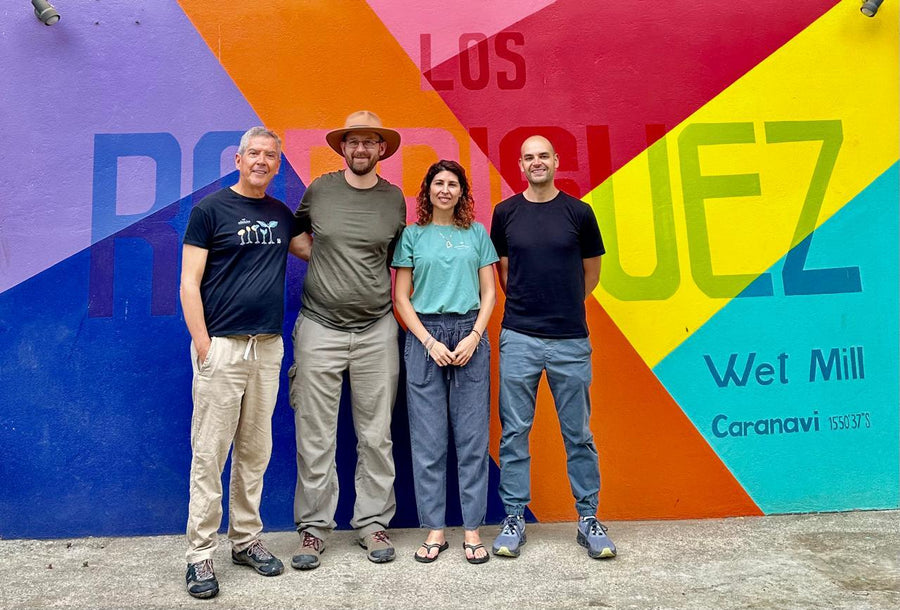
Fincas Los Rodriguez
-
*Our Special Reserve coffees are offered in 125g bags - a smaller measure that reflects their rarity and quality, and a way to make these exceptional lots more accessible to those seeking something truly unique*
Jasmine florals burst through up front, followed by creamy lemon curd and bright lime zest, with a gentle shoulder of mango lingering on the finish.
Geisha needs no introduction. Originally discovered in the cloud forests of southwestern Ethiopia in the 1930s, this variety has become something of a legend in specialty coffee - known for its hauntingly floral aromatics, delicate sweetness, and an elegance that sets it apart from just about everything else.
But Geisha is famously fussy. The plants are delicate, with thin foliage and weak root systems that make them low-yielding and tricky to cultivate. It takes real commitment to grow it well - the sort of meticulous, scientific approach that the Rodriguez family have made their hallmark at Finca Las Alasitas.
Tucked into the steep green valleys of Bolinda, just outside Caranavi, Las Alasitas sits at around 1,642 metres above sea level. The farm was established in 2014 as part of Agricafe's ambitious project to revive Bolivia's declining coffee industry, and it now serves as the family's variety nursery - a kind of experimental hub where agronomist Rodrigo Frigerio tends to seedlings of Geisha, Java, Caturra and San Bernardo. Cool nights and mild days slow the ripening of cherries here, allowing sugars to concentrate and complexity to build. It's exactly the kind of environment where Geisha can really sing.
This lot was processed using what the Rodriguez family call the "Coco Natural" method – a name they coined themselves. It's a hands-on, small-batch approach to natural processing that starts with picking only the ripest cherries, selected by colour and checked for sugar content. Pickers from the nearby Villa Rosario community make multiple passes through the farm throughout harvest, trained to select only the very ripest fruit – almost purple, according to the family. After picking, cherries are sorted by density using water, then disinfected in a high-capacity machine the team affectionately call 'La Maravilla' (Spanish for 'the wonder'). From there, they're laid out on patios to dry for 48 to 72 hours, depending on the weather. This initial stage kicks off fermentation and gives the cherries a head start before the next phase.
Then comes the bit that gives the process its name. The cherries are transferred into what the team at Buena Vista call "stationary box" dryers - large steel containers originally designed for drying cocoa pods. Warm air flows gently up from beneath the coffee bed, keeping temperatures below 40°C, while the cherries are stirred manually at regular intervals to ensure even drying. Over 40 to 50 hours, the fruit slowly dries down to a stable 11.5% humidity. As it does, it turns a deep reddish-brown – a bit like cocoa powder, which is where the "Coco" nickname comes from. It's a thoughtful, controlled process that draws out loads of fruit character while keeping the cup clean and balanced – exactly what you want from a natural Geisha. If you would like to find out a little more about the coco natural process, make sure to check out our deeper dive on it here.
The farm's name, Alasitas, comes from an ancient Bolivian festival honouring Ekeko, the Aymara god of abundance. Every year on 24th January, people gather to buy miniature versions of the things they hope to receive – houses, cars, diplomas, even tiny coffee bags – believing that these small tokens can grow into something real. It's a fitting name for a farm built on vision and possibility, where the Rodriguez family continue to plant seeds – literally and figuratively – for the future of Bolivian coffee.
-
You'll spot this variety spelled both ways across the specialty world. Gesha is arguably more historically accurate – derived from the Amharic name for the Gori Gesha forest (ጌሻ) in Ethiopia where the variety originates. The Geisha spelling dates back to the 1930s, when British collectors first catalogued the variety and likely wrote down what they heard. As the coffee made its way to Costa Rica and then Panama, that spelling stuck. We take our lead from what the producers themselves put on the bag. The Rodríguez family use Geisha, so that's what we use too.
-
You might receive a bag with a 'roasted on' date a little further back than you'd normally expect from us. That's entirely deliberate - and it's all about getting this coffee to you at its absolute best.
Here's the thing: freshly roasted coffee needs time to settle. During roasting, CO2 gets trapped inside the bean, and if you brew too soon, that gas escapes all at once - creating bubbles that actually block water from properly extracting all those lovely flavours. The result? A cup that's a bit all over the place. For most of our coffees, we ship within five days of roasting. But this natural-process Geisha is different. We've been cupping it obsessively, and it really hits its stride around the 14-day mark - when those tropical fruit notes fully develop and the sweetness comes into focus.
So for this coffee, we've extended our freshness window to 10 days post-roast. You might still receive a bag that's only a few days old, but if yours is closer to 10 - that's a good thing. Think of it like a wine that needs time to open up. A slightly older roast date on this one isn't a compromise; it's the coffee getting closer to its peak.
-
- Country: Bolivia
- Region: Yungas
- Province: Caranavi
- Colony: Bolinda
- Farm: Las Alasitas
- Elevation: 1,642 m.a.s.l.
- Producers: Fincas Los Rodriguez
- Processing Method: Coco Natural
- Varietal: Geisha
-
Medium
We're taking this one through the gap and letting it develop a little before dropping – comfortably before second crack. Here's the thinking.
Geisha is famously delicate. Those jasmine florals and tea-like qualities that make the variety so prized are the first things to disappear if you push the roast too far. At the same time, this is a natural process, and a fairly intensive one at that – all that time in the Coco dryers has already done a lot of the heavy lifting in terms of building body and fruit character. The coffee doesn't need us to add much; it just needs space to express what's already there.
By allowing a little development time in the gap, we're giving the sugars a chance to caramelise properly, which brings out that creamy lemon curd sweetness and rounds off the bright citrus acidity without flattening it. Drop it too early and you risk a sharp, underdeveloped cup that doesn't do justice to the mango and tropical fruit notes the Coco Natural process has worked so hard to create. But take it too close to second crack and you'll start losing the florals – and once they're gone, they're gone.
The goal is balance: enough development to let the sweetness and body sing, but light enough to preserve the elegance and clarity that makes this Geisha special. Think bright but not sharp, sweet but not heavy, floral but grounded.
-
Tasting Notes: Jasmine, lemon curd, lime zest.
Cup of Excellence Cupping Scores
- Clean cup: 8/8
- Sweetness: 7/8
- Acidity: 7/8
- Mouthfeel: 6/8
- Flavour: 7/8
- Aftertaste: 6/8
- Balance: 6/8
- Overall: 7/8
- Correction: +36
- Total: 90/100
If you would like to find out more about how we score coffees, and why this coffee scoring 90 points is a big deal, make sure to read our blog post "What Do Coffee Cuppings Scores Actually Mean?" by clicking here.
-
We're going to guess we're probably only speaking to the filter coffee brewers out there! Here's how we're enjoying this coffee at Ozone HQ.
Kalita Wave (or equivalent flat bottomed brewer e.g. April brewer) using wave filter papers.
15g of coffee vs 250ml of water
- 0:00 - pour 50g evenly covering all coffee grounds for a 30 second bloom
- 0:30 - pour 100g in 2 distinct motions: 50g circular pour around the brew bed/50g centre pour focusing in the middle of the brew bed (aim to complete this within 10-15 seconds)
- 1:10 - pour 100g in 2 distinct motions: 50g circular pour around the brew bed/50g centre pour focusing in the middle of the brew bed (aim to complete this within 10-15 seconds)
Your total brew time should be between 2:30 and 3:00, but don't stress if it isn't - taste what you've brewed and adjust what you're doing accordingly. A simple correction like changing your grind size will make a big difference to the total time, but only do so if you feel the extraction you're getting needs adjusting - it is completely possible that a brew in your home of a shorter/longer time than what we achieve here in Stafford might taste fantastic! You could also look to exert some control over the brew time via the vigorousness of your 2 x 50g centre pours - pour more softly to extend the brew time or pour with more oomph to go for a shorter brew time.
-
Our coffee is roasted fresh and ships quickly - which means it might arrive a little lively. Here's the thing: freshly roasted beans are still busy releasing carbon dioxide (a natural byproduct of roasting), and all that activity can make your brew taste a bit sharp or unsettled.
Give it time to calm down and something lovely happens. Those brighter, edgier notes mellow out, sweetness develops, and the flavours you're actually after can really come into focus.
For this particular coffee, we recommend resting for at least 10–14 days from the roast date on the bag before brewing. We've been cupping it obsessively, and it really hits its stride around the 14-day mark - that's when the tropical fruit notes fully develop and the sweetness comes into focus. A little patience goes a long way with this one.
That said, this is just what we've found works best - not a rule. If you can't wait, we completely understand. Tuck in whenever you like.
-
-
Producer Stories
Learn more about coffee sourcingFincas Los Rodriguez
Fincas Los Rodríguez is a family-run coffee project led by Pedro and Daniela Rodriguez, focused on producing high-quality, traceable coffees across twelve farms in Bolivia’s Caranavi and Samaipata regions.
Read more