-
This is In My Mug coffee number 931, roasted and posted to subscribers on Friday 11th September 2026.
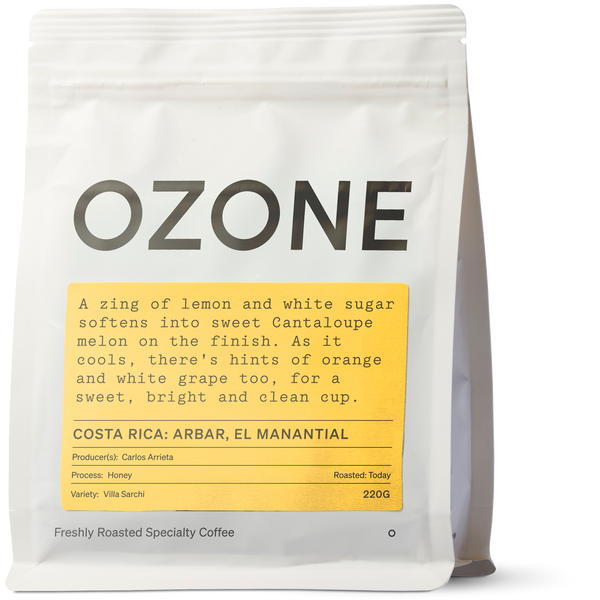
A zing of lemon and white sugar softens into sweet cantaloupe melon on the finish. As it cools, hints of orange and white grape arrive too, for a cup that's sweet, bright and properly clean.
In 2013, a sample turned up on a cupping table in San José with hardly anything written on it. No farm name. No mill name. Just a man's name, Carlos Arrieta, because the mill he'd built didn't have a name yet.
Thirteen years later we're still buying almost everything he grows.
How much do you like it?
The cupping was at the offices of Exclusive Coffees, run by Francisco Mena, and the man behind the table was Stephen Leighton of Hasbean. The coffee stood out immediately. Carlos was sent for, and what followed has been repeated enough times since to have hardened into legend.
"How much do you want?"
"How much do you like it?"
"A lot."
"I'd like a lot then, please."
"OK..."
Somebody from the exporter's team intervened before Stephen managed to sign away his house and his car. A fair price was settled on, more than Carlos had ever been paid for his coffee. That first year the lot went out under his own name. The following year it became Arbar, a splice of Carlos ARrieta and Maria BARboza, which is about as concise a summary of who runs this place as you could ask for. Hasbean joined Ozone in 2018, and the relationship carried straight across.
The road
Before any of that, Carlos was doing what almost everyone in Costa Rica did. Cherries went to the co-op, the co-op did the processing, and whatever was distinctive about a particular farm vanished into a regional blend. You could buy a Tarrazú. You couldn't buy a Carlos.
The road Arbar sits on made the alternative hard to ignore. It reads like a Cup of Excellence roll call. Vista Al Valle is there, owned by Oldemar Arrieta Lobo, Carlos's cousin. Herbazu, owned by Tonio Barrantes Zuñiga, his neighbour. A little further along is Sumava, owned by Francisco Mena, the same exporter who would eventually put that unnamed sample in front of a buyer. Neighbours, relatives and friends, all of them building their own mills and getting their own names on bags.
Carlos and Maria watched it happen and thought they might have a go. The hunch was correct.
This is your home now
Roland, our Green Buyer, first came here in 2015, the year he sat on the Costa Rica Cup of Excellence jury. Arbar was the first coffee farm he ever visited, and he'll tell you it's still one of the most vivid memories he has.
He spoke no Spanish at the time. He was chaperoned out to the farm by Wayner from Exclusive Coffees, who at that point spoke very little English. Carlos and Maria speak only Spanish. On paper, a difficult few days.
It was sorted before anyone had managed a single introduction. Carlos pulled Roland into an enormous hug and told him, "Welcome. You're one of us, this is your home now." He was walked round the farms, sat at the head of the table when everyone ate together, and taught a handful of Spanish phrases. The important one, obviously, was Pura Vida.
It translates as "pure life", which undersells it. How are you? Pura vida. Had a rotten day? Pura vida. It's a greeting, a shrug, a celebration and a consolation, and it does all four without breaking stride.
Read the full Arrieta Barboza family producer story →
Five farms
The mill is near Lourdes de Naranjo in Costa Rica's West Valley, at 1,600 metres. Drying beds, depulper and nursery are all arranged around the family house, and the house sits in the middle of El Manantial, the farm this lot comes from.
El Manantial is the biggest of the five and the centre of everything, roughly three hectares producing around 8,500kg of cherry a year, which comes down to a little over 1,000kg of green coffee once it's been through the mill. El Oasis is slightly smaller and yields around 6,000kg. La Casa is the experimental one, given over largely to Geisha and Kenya. La Isla is owned by Maria's niece and managed by Carlos and Maria under a long-term arrangement, 1.4 hectares at 1,400 metres planted with a mix of Villa Sarchi, Kenya, Geisha and Ethiopian varieties.
The fifth is Don Pedro, and it's there because of a conversation. Pedro Aguilera's father once owned a great deal of the land around this part of the valley. It was divided between his children over time, and most of them chose not to stay in coffee. When Pedro mentioned to Esteban Arrieta that he was struggling to manage four farms with nobody to hand them to, Esteban suggested the family take one on. They've had it on an eight-year lease since, replanting, pruning and rebuilding the soil.
None of it is certified organic, but the practices are mostly organic anyway. Fruit trees are planted in among the coffee for shade, for the soil and for the kitchen. Sheep wander about. There are goats, chickens and fish. The aim is to need as little from outside as possible.
The Bourbon that shrank
Somewhere in the 1950s or 60s, farmers in the town of Sarchí noticed that some of their Bourbon plants were coming up short. Not sickly, just small, with a tight compact frame that happened to suit the steep ground they were farming.
What they'd found was a single gene flipping, the same trick that produced Caturra in Brazil and Pacas in El Salvador. Three countries, three separate mutations, three near-identical answers to the same problem. This one got called Villa Sarchi after the town it turned up in.
It grows to about waist and chest height with branches angled upward at roughly 45 degrees, so no ladders. The young leaves come through bronze against the mature green, which makes it easy to pick out in a mixed plot. In the cup it does what the Bourbon line does, sweet and fruit-forward, but with more precision to it. Cleaner edges, brighter acidity, every note sitting where you can see it.
The catch is rust. Villa Sarchi has essentially no resistance to it, and the 2012 to 2013 epidemic that tore through Central America took out a great many plantings. Plenty of farms switched to something hardier and stayed switched. Growing it now means watching it closely, managing shade properly and accepting the risk, which is why you tend to find it on farms where quality is the whole point.
It also gave far more than it took. In the 1960s researchers in Portugal crossed Villa Sarchi with the Timor Hybrid and produced Hybrid 361, the foundation of the entire Sarchimor family. T5296, Marsellesa and Parainema all descend from it. A good chunk of what keeps Central American coffee farming viable today traces back to a short plant in a small Costa Rican town.
Our full guide to the Villa Sarchi varietal →
Sugar left on the bean
This lot is honey processed. The skin comes off, but the sticky layer of mucilage underneath is left on the bean while it dries, so the fruit sugars have time to work inward rather than being rinsed away.
It's a middle path between washed and natural, and it asks for attention. Left on the beds without turning, that sugar layer will do the wrong sort of fermenting. Done properly, you get the clarity of a washed coffee with a rounder, sweeter middle. On a varietal like Villa Sarchi, which already delivers clean lines and bright acidity, it fills things out without blurring anything.
Esteban
Ask Roland how you know whether a relationship with a farm is doing what it's supposed to, and he'll point at Esteban, the eldest of the four Arrieta Barboza children.
When Roland first met him, Esteban was working in cattle. That happens constantly. Children grow up on coffee farms and leave for something that pays, and nobody blames them for it. Then, a few years back, he took a job at the Sumava mill down the road and was very good at it. He moved to an exporter. Today he works for Exclusive, our exporting partner, and he's bought a piece of farmland of his own directly next to Oasis.
That's the entire argument for paying properly, standing in one place wearing work boots. Maria still runs much of the processing and roasts for the local market, a skill she picked up as a child over a fire with her father. Nacho helps on the farms and has taken a real interest in cupping. Yessica and Karen have careers elsewhere and the family is no less close for it.
When we started buying we took every bean Arbar produced. They're a good deal more efficient now and the crop is bigger, so we no longer take all of it, though we still take a large share.
Maria and Carlos run coffee tours these days, which is worth knowing if you ever find yourself planning a holiday in Costa Rica. They're deep in their community too. Last time we visited, Roland and Paul, our Head Roaster in New Zealand, ended up at a rodeo fair, a serious event in a rural agricultural neighbourhood. There are, sadly, no photographs of Roland falling off anything.
On that same trip, everyone was stood outside the house with a coffee when the local fire crew turned up. Maria has a small roaster in the back and roasts for the neighbourhood, and they'd come to buy some. She carried on roasting, they had a mug and a chat, and then they went back to work. That is very much the shape of a day here.
Traceability
- Country: Costa Rica
- Region: West Valley
- Nearest town: Lourdes de Naranjo
- Micromill: Arbar
- Farm: El Manantial
- Producer: Carlos Arrieta and family
- Elevation: 1,600 m.a.s.l.
- Variety: Villa Sarchi
- Processing method: Honey
- Relationship since: 2013
Cupping scores
Cupping notes: Lemon, melon, white grape.
Cup of Excellence Cupping Scores
- Clean Cup: 6.5/8
- Sweetness: 6.5/8
- Acidity: 6.5/8
- Mouthfeel: 6/8
- Flavour: 6.5/8
- Aftertaste: 6/8
- Balance: 6.5/8
- Overall: 6.5/8
- Correction: +36
- Total: 87/100
If you'd like to find out more about how we score coffees, have a read of What Do Coffee Cupping Scores Actually Mean?, and if you fancy trying cupping yourself, we've got a guide to that too: What is Coffee Cupping.
Roasting information
Medium - taken through the gap and not allowed anywhere near second crack. The point here is to let the simple sweetness do the talking.
931 - Costa Rica: Arbar - El Manantial

The Arbar micromill is owned by the Arrieta Barboza family. That includes Carlos and Maria, and their children Yessica, Karen, Esteban and Jose Ignacio. Their house is right next to their micromill, which is laid out immaculately.
Get the coffee