-
This is In My Mug coffee number 932, roasted and posted to subscribers on Friday 18th September 2026.
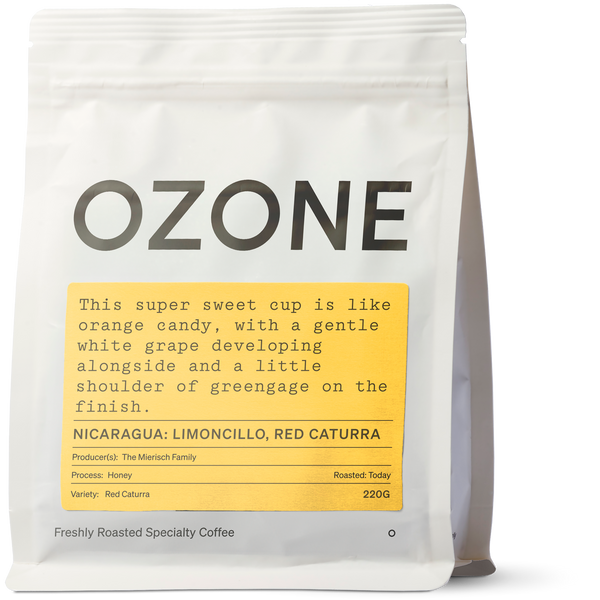
This super sweet cup is like orange candy, with a gentle white grape developing alongside and a little shoulder of greengage on the finish.
A few weeks ago, IMM 927 was a washed Ethiosar from this same farm. This week's coffee comes from the same ground but couldn't be more different: a honey processed Red Caturra, the second single origin we're featuring on In My Mug from this year's Nicaraguan harvest.
Same farm, new ground
Finca Limoncillo sits in the Yasica Norte municipality of Matagalpa, Nicaragua. It's a big piece of land: 171 hectares in total, 109 of them under coffee, with 54 more set aside as protected rainforest. It's the largest of the farms our Green Buyer Roland visits on his trip to Nicaragua each year. The Mierisch family have grown coffee here since long before we started buying it, and Caturra is one of several varietals planted across the estate, alongside Javanica, Yellow Pacamara, Gesha, Catuai, and Yellow Pacas
A plant built to multiply
Red Caturra has one of the more accidental origin stories in coffee. It turned up as a spontaneous mutation of Red Bourbon on a farm in Minas Gerais, Brazil, sometime between 1915 and 1918. Nobody bred it, it simply appeared, with a single genetic change shortening the gaps between its branches to give it a smaller, denser shape than Bourbon. The name is thought to come from a Guarani word meaning "small", which about sums it up.
That compact shape mattered enormously in practice: shorter, denser plants meant producers could fit more trees into the same plot, and pruning and harvesting got easier too. Caturra reached Guatemala in the 1940s, then spread to Costa Rica, Honduras and Panama, before arriving in Colombia in 1952, where at its peak it's thought to have made up close to half the country's entire coffee production. Grown well and at altitude, as it is here at Limoncillo's 1,200 metres, it keeps Bourbon's sweetness and complexity while adding a cleaner, brighter edge. It's the dependable varietal that quietly built modern specialty coffee.
Our full guide to the Caturra varietal →
Precision at the mill
Every coffee from Limoncillo passes through the Don Esteban mill, named after the family patriarch, where eco-pulpers give the team precise control over how much mucilage stays on the bean. It's that control that makes honey processing possible: instead of washing the sticky, sugar-rich layer off after depulping, it's left on the bean during drying on covered, raised beds.
Wingo has spent the past several years pushing processing experimentation at Don Esteban, and honey lots like this one are where that work shows up most directly in the cup. Left on rather than washed away, the mucilage's sugars work into the bean as it dries. That's a large part of why this coffee lands so sweet. That orange candy character up front isn't an accident of variety alone.
A result from years back
Limoncillo's quality isn't a recent discovery. Back in 2008, a coffee from the farm took 2nd place at Cup of Excellence, one of the earliest signs of what this ground was capable of, long before Wingo or the Don Esteban mill's more recent processing work came along. Almost two decades on, it's still delivering.
Read the full Mierisch family producer story →
Traceability
- Country: Nicaragua
- Region: Matagalpa
- Municipality: Yasica Norte
- Farm: Limoncillo
- Producer: The Mierisch Family
- Farm size: 171 hectares
- Coffee growing area: 109 hectares
- Protected rainforest: 54 hectares
- Elevation: 1,200 m.a.s.l.
- Variety: Red Caturra
- Processing method: Honey
- Harvest months: October–February
- Relationship since: 2007
Cupping scores
Cupping notes: Orange candy, white grape, greengage.
Cup of Excellence Cupping Scores
- Clean Cup: 6.5/8
- Sweetness: 7/8
- Acidity: 6/8
- Mouthfeel: 6.5/8
- Flavour: 6.5/8
- Aftertaste: 6/8
- Balance: 6.5/8
- Overall: 6/8
- Correction: +36
- Total: 87/100
If you'd like to find out more about how we score coffees, have a read of What Do Coffee Cupping Scores Actually Mean?, and if you fancy trying cupping yourself, we've got a guide to that too: What is Coffee Cupping.
Roasting information
Medium Dark: this coffee is taken through the gap between cracks and allowed to develop a little, paying close attention to the heat and dropping the roast before second crack.
932 - Nicaragua: Finca Limoncillo, Red Caturra, Honey

Finca Limoncillo is located in Matagalpa and, at 171 hectares in size, it. is. huge! Situated at an amazing location, it boasts nine waterfalls within the farm and is owned by the Mierisch family; They’re known for their experimental processing, varietal work, and exceptional coffee.
Get the coffee