-
This is In My Mug coffee number 935, roasted and posted to subscribers on Friday 9th October 2026.
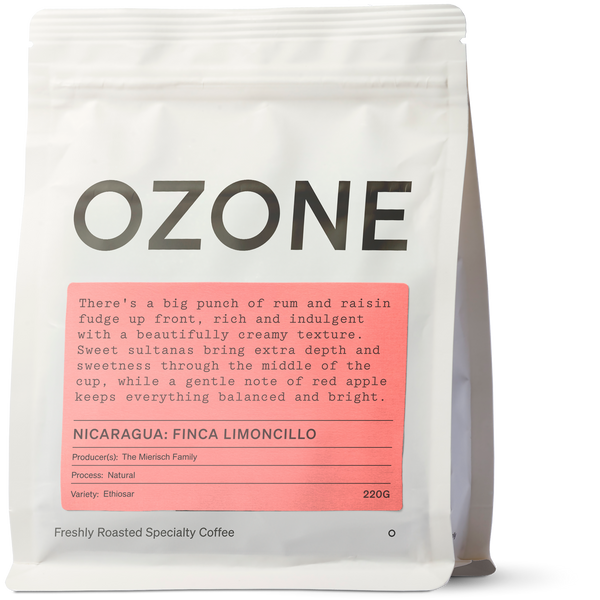
A big, creamy hit of rum and raisin fudge leads the way, rich and indulgent, with plump sultanas adding depth and sweetness through the middle. Then a fresh kick of red apple lifts the finish, giving this classic natural a bright, playful edge.
This is the third single origin we've released from Finca Limoncillo this harvest, and the second Ethiosar. If you had IMM 927 back in August, you've already tasted this varietal from this farm, grown by this family. You haven't tasted it like this.
That's one of the quiet joys of buying from the same producers year after year. You might assume that nineteen years of coffee from one family would start to blur together. With the Mierisch family, it's gone the other way. The more we buy, the more range we find, because coffee this well grown and this carefully processed can be pushed in all sorts of directions and still taste like itself.
Ethiosar, every which way
Ethiosar has been a regular in our lineup for years now, and between us and the Mierisch family we've worked our way through just about every processing method going.
Back in IMM 624 it was a pulped natural that tasted just like a Twix: milk chocolate up front, caramel as it cooled and a biscuity finish. In 873, last summer, it was a natural bursting with plum, orange and red berries. A couple of months later, 881 was a honey process full of shortbread, dark toffee and sultanas. This August's washed lot in 927 went fudgy, with pecan and yellow plum. And now this natural, which shares a process with 873 but lands somewhere completely different: deeper, creamier and more like a dessert than a fruit bowl.
Same farm, same varietal, same family. A different coffee every time. Harvest conditions shift from year to year, every lot is picked and dried on its own terms, and the team at the mill make fresh decisions about each one. That's what we mean when we talk about long-term relationships giving us range rather than repetition.
Read our full guide to the Ethiosar varietal →
The apple that keeps coming back
For all that variety, there's one note that keeps turning up in Limoncillo coffees, whatever the varietal and whatever the process: apple.
That Twix-like pulped natural in 624 had a delicate green apple edge balancing out all the chocolate and caramel. In IMM 673, we called a washed Caturra from Limoncillo our most consistent coffee, and said we'd come to expect toffee apple jumping out of the cup every year. The honey Ethiosar in 881 finished on a gentle cooked apple. And here it is again, this time as crisp red apple, cutting through all that rich fudge and dried fruit.
We wouldn't want to pin it on any one thing. Limoncillo's warm days and cool nights, the soils, the way the family farm and process, all of it plays a part. But when a flavour survives this many different varietals and processing methods, it starts to feel like the farm's signature, and it's always a pleasure to find it again.
How Limoncillo dries a natural
Natural processing is the oldest way of handling coffee, and in principle the simplest: pick the cherry, dry it whole, then strip off the shrivelled fruit to reveal the bean. In practice it's one of the hardest to get right, because the fruit stays wrapped around the bean for weeks and there's a lot of room for things to go wrong.
While the cherry dries, yeasts and bacteria living on the fruit get to work on its sugars, producing alcohols, esters and organic acids that slowly make their way into the bean. That's where a natural gets its fruit-forward, often boozy character, and where the dried fruit notes you'll find in this cup come from. Control it well and you get something sweet, rich and integrated. The skill is all in the control.
The Mierisch family's naturals start in the field, with only fully ripe cherry picked and then floated in water so any underdeveloped or defective fruit can be removed. The cherries then make the journey of around 45 minutes to an hour to the family's Don Esteban mill. There's no concrete patio drying here. Instead, the cherries go out in thin layers on tarps laid over a black mesh that lets air move underneath, spending around four days in full sun to bring the moisture down quickly and keep fermentation in check.
After that, they move to raised beds under heavy shade for a much slower finish, with the whole drying process typically taking around a month. Once dry, the coffee rests in its cherry for a while longer so the moisture can even out through every bean before it's milled and prepared for export. It's patient, hands-on work, and it's a big part of why the family's naturals taste so clean and focused.
Read our full guide to natural processing →
Built to last
We've told Ethiosar's origin story a few times now: the family's cousin Ricardo, his farm at 800 metres, and the one experimental plant that outperformed everything around it (on the farms, it's still often called "Ricardo" after him). What's worth digging into this time is how it was bred, because that's where it gets clever.
Ethiosar starts with a cross between Sudan Rume, a rare Arabica associated with the Boma Plateau in South Sudan and prized by breeders for its cup quality, and Sarchimor, a line bred from Villa Sarchi and the Timor Hybrid for strong resistance to coffee leaf rust.
If that pairing sounds familiar, it should. Sudan Rume and Sarchimor are also the parents of Centroamericano H1, which you might remember from Finca Argentina in IMM 928. Centroamericano is an F1 hybrid: a first-generation cross with plenty of vigour, but one that has to be propagated clonally to stay true to type.
Ethiosar took a different route. Its offspring was crossed again with Villa Sarchi, a compact Bourbon mutation from Costa Rica, and then selected over successive generations. The result is a plant that can be grown from seed with far more consistency, which makes it much easier for farmers to plant and share. It's also a strong yielder: the family's figures put it at up to around 40% more coffee than Caturra, from roughly 2,800 plants per manzana against more than 4,000 for Caturra.
Productive, resilient and genuinely delicious. It's exactly the kind of practical, farmer-led innovation the Mierisch family have built their reputation on.
Good people grow good coffee
Behind every one of those decisions at the mill and in the field is a team that has, in many cases, been with the family for a very long time.
Erick Lopez is a good example. He's now Head Agronomist across the Mierisch farms, overseeing much of their day-to-day running, but he started out at entry level, working in the fields some 22 years ago. The family spotted his talent and commitment, promoted him, and paid for his further education to help him get where he is today. Alongside him, fifth-generation Erwin "Wingo" Mierisch leads the development of new processing methods at Don Esteban and has sharpened the lab's quality control, which is a big reason lots like this one are so consistent.
Limoncillo is home as well as a workplace. More than 60 families live on the farm year-round, with free housing, meals, childcare and healthcare, on-site schools, and wages set at 30% above the local minimum. In 2024 the farm also completed its own hydroelectric plant, supplying renewable energy to both the farm and the families who live there. Of all the producers we buy from, there's nowhere we see more genuine warmth between a family and the people who work alongside them. It's a big part of why we keep coming back.
Read the full Mierisch family producer story →
Traceability
- Country: Nicaragua
- Region: Matagalpa
- Municipality: Yasica Norte
- Farm: Finca Limoncillo
- Producers: The Mierisch family
- Farm size: 171 hectares
- Coffee growing area: 109 hectares
- Protected rainforest: 54 hectares
- Varietal: Ethiosar
- Processing method: Natural
- Elevation: 1,200 m.a.s.l.
- Harvest months: October to February
- Diurnal temperature cycle: Average high 25°C, low 17°C
- Relationship since: 2007
Cupping scores
Cupping notes: Rum and raisin fudge, sultana, red apple.
Cup of Excellence Cupping Scores
- Clean Cup: 6/8
- Sweetness: 6.5/8
- Acidity: 6/8
- Mouthfeel: 7/8
- Flavour: 6.5/8
- Aftertaste: 6.5/8
- Balance: 6/8
- Overall: 6.5/8
- Correction: +36
- Total: 87/100
If you'd like to find out more about how we score coffees, have a read of What Do Coffee Cupping Scores Actually Mean?, and if you fancy trying cupping yourself, we've got a guide to that too: What is Coffee Cupping.
Roasting information
Medium dark - keep this going steadily, through the gap and up to the cusp of second before you finish the roast.
935 - Nicaragua: Finca Limoncillo, Ethiosar, Natural

The Mierisch family have been growing coffee for more than 100 years and are some of our closest friends in coffee. Across their farms in Nicaragua and Honduras they're known for combining meticulous quality standards with a spirit of experimentation, all underpinned by a deep respect for the people who make their coffees possible.
Get the coffee