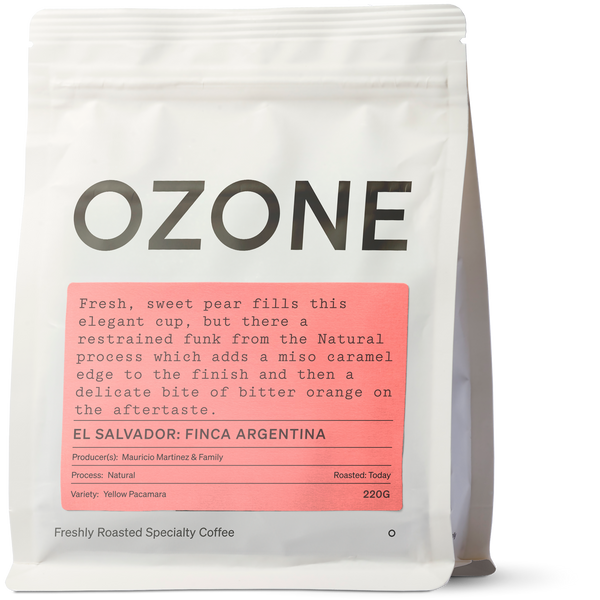
Here at Ozone, we really like Pacamara. We've spent years buying it, tasting it, talking about it with producers and occasionally getting rather carried away discussing it over a few rums at origin.
It's also a variety that can be genuinely difficult to pin down. Some Pacamaras are extraordinary. Others are decidedly not. Its unusual genetics, enormous beans and the way it behaves on the farm and in the roastery all make it a variety we've kept coming back to.
A quick caveat before we get into it: some of what follows comes from our own experience and conversations with producers, rather than published research. Those conversations have often been in places where English isn't the first language, so where the historical record is less clear, we've tried not to pretend otherwise.
What is Pacamara?
Pacamara is a cross between two very different coffee varieties: Pacas and Maragogipe.
Pacas is a compact natural mutation of Bourbon, discovered in El Salvador. Maragogipe is a much larger mutation of Typica, first identified in Brazil. Put the two together and you get Pacamara: a relatively compact plant with exceptionally large leaves, cherries and beans.
The Pacamara Family Tree
Pacamara
Created at the Salvadoran Institute for Coffee Research (ISIC), this cross between Pacas and Maragogype took over 30 years to stabilise. The result is far greater than the sum of its parts, one of specialty coffee's most complex, unpredictable, and rewarding varietals. When it's good, it's extraordinary.
The mother: Pacas
Pacas is a natural mutation of Bourbon, much like Caturra in Brazil or Villa Sarchi in Costa Rica. Its compact growth makes it possible to plant more trees in a given area, which is one reason it became so important in El Salvador.
The variety was discovered in 1949 on a farm belonging to the Pacas family in the Santa Ana region. The family had already noticed unusual trees performing well on the farm, and the plants were eventually investigated by researchers from the Salvadoran coffee industry.
There is a slightly better-known version of the story involving a misplaced label and a visiting botanist who remembered the family name instead. It's a good story, and one you'll find repeated in coffee circles, but the basic fact is the useful bit: Pacas is a Salvadoran Bourbon mutation that became one of the country's most important varieties.
In the cup: Pacas can produce sweet, clean and balanced coffees, although in our experience the best lots tend to come from particularly good farms and careful processing rather than from the variety name alone.
The father: Maragogipe
Maragogipe is a natural mutation of Typica first identified near the Brazilian town of Maragogipe in Bahia in 1870. It is famous for its size. The trees have large leaves and widely spaced nodes, while the cherries and beans can be enormous.
Large beans are part of the appeal, but bean size itself isn't a measure of cup quality. We've tasted Maragogipe from Brazil, Guatemala and Mexico and seen plenty of variation between lots. Good farming and good processing matter much more than how impressive the green beans look in the sample tray.
In the cup: Maragogipe can show bright acidity, citrus and floral flavours, but it has a reputation for being variable. The really good lots are much harder to find than the giant beans might suggest.
How Pacamara came to be
The cross that produced Pacamara was made in El Salvador in 1958 by the genetics department of the Instituto Salvadoreño de Investigaciones del Café (ISIC).
Researchers crossed Pacas with Red Maragogipe and began selecting the resulting plants for useful combinations of productivity, plant structure, fruit size, adaptability and cup quality. This wasn't a quick process. Several generations were grown and evaluated before the fifth generation, or F5, was distributed to farmers.
Pacamara is also notoriously variable. The plants don't always breed true, and some seedlings can revert towards one of the parent varieties. Estimates vary, but around 10–15% is commonly reported. Nursery selection is therefore important: growers can identify plants that don't show the expected Pacamara characteristics and remove them before planting them out.
It's an unusual characteristic for a variety that has become so closely associated with high-end coffee, but it helps explain why Pacamara lots can vary considerably from one farm, or even one planting, to another.
So what makes Pacamara so good?
This is the part we keep coming back to.
Pacas and Maragogipe are both interesting varieties, but neither is especially consistent when it comes to producing exceptional cups. Pacamara can be a different story.
At its best, it is remarkably expressive. You can get tropical fruit, citrus, florals, spice and a huge amount of sweetness alongside a distinctive creamy texture. There's also a savoury side that can appear in some lots, particularly where fermentation and processing have been pushed further.
Then there are the bad ones. Poorly grown or processed Pacamara can be vegetal, muddy, mushroomy or simply flat. We've spent more time than we'd like to admit trying to work out why some lots are brilliant while others really aren't.
Part of the answer is probably genetic variation. The rest comes down to the usual suspects: farm, climate, ripeness, processing, drying and roasting.
Our work with Limoncillo
We first came across Yellow Pacamara at Finca Limoncillo in Nicaragua in 2012. We wanted some immediately, but the Mierisch family were using the crop to produce planting material and weren't ready to sell it.
That started a relationship with the variety that has continued ever since.
One of the things we value most about working with producers is that the experiments have to make sense to them first. We'd never tell a farmer how to grow or process their coffee. We're much more interested in asking what they're curious about and seeing what we can learn together.
That approach led to some memorable experiments with natural Pacamara at Limoncillo. Eleane Mierisch noticed that the drying method was changing the character of the coffee on the cupping table, so the team began experimenting with how frequently the drying coffee was turned.
One lot was turned every hour. Another continued on the farm's usual two-hour schedule.
When we tasted them, the hourly-turned lot was noticeably cleaner. Someone described it as elegant. It was a good coffee, but we also missed the slightly wild character we'd found in previous Limoncillo Pacamaras.
Then we tasted the other lot.
“Funky” was the first word that came out.
And that was that: Elegant and Funky. The Mierisch team continued experimenting with drying-bed depth and drying speed from there. It was a good example of the sort of small, practical experiment that can tell you more about a coffee than any generic processing recipe.
Roasting Pacamara
Those huge beans make Pacamara interesting for a roaster, too.
The basic roast chemistry hasn't changed. The physical size of the bean has.
Large Pacamara beans take longer for heat to reach the centre. Push the roast too aggressively and the outside can develop faster than the middle, leaving you with a bean that looks done while the centre remains underdeveloped.
That means heat application needs more attention than it might with a smaller coffee. Slower, more controlled profiles can help the centre catch up without scorching the outside.
There's another visual trap, too. Pacamara beans can look lighter and less developed than you'd expect from the way they taste. We've learned not to rely on colour alone when judging the roast.
Our approach isn't a fixed recipe. Different Pacamaras behave differently, and moisture, density, processing and crop age all change how the coffee responds in the roaster. The useful starting point is simply to remember that very large beans need enough time for the centre to develop.
Yellow Pacamara
Yellow Pacamara is one of the reasons we wanted to write this article in the first place.
The story starts at Finca Limoncillo in Nicaragua. Around 2004, a security guard noticed a few Pacamara trees carrying yellow fruit among the usual red cherries. The trees were initially noted and left alone. When the security guard later became farm manager, he brought them back to the Mierisch family's attention.
The family isolated the trees, saved seed and gradually built up enough plants to produce the coffee commercially. As with any new coffee planting, this took time. A coffee tree doesn't exactly rush the process.
The first full harvest produced just 240kg. The coffee was divided into two lots for the Los Favoritos Fincas Mierisch auction. We tried to buy both, but the bidding went beyond what we could justify. We managed to secure one.
In the cup: Yellow Pacamara can be strikingly different from the red-fruited type. When we cupped the two blind, the yellow lot showed peach, apricot and tropical fruit, with a creamy mouthfeel and plenty of sweetness. The red-fruited Pacamara was more citrus-led, with lemon pith, bright acidity and a slightly hop-like character.
They're different coffees from the same broader family, and that's exactly what makes them so interesting.
Why we keep coming back
Pacamara is difficult to predict, which is part of the fun.
The variety has enormous genetic and physical quirks, but the best reason to pay attention to it is much simpler: good Pacamara can be absolutely delicious.
It can be expressive, sweet, bright, savoury, creamy or fruit-heavy depending on where it was grown and what happened to it after picking. That's why we keep asking producers questions, tasting new lots and occasionally getting stuck into another round of experiments.
We're still learning about it. That's probably why we like it so much.
Quick varietal facts
Varietal: Pacamara
Species: Coffea arabica
Parentage: Pacas × Maragogipe
Developed in: El Salvador
Breeding programme: Instituto Salvadoreño de Investigaciones del Café (ISIC)
First cross: 1958
Initial release: 1980
Successful commercial launch: 1992
Growth habit: Compact to medium-tall, with large leaves and long lateral branches
Cherry colour: Red in the standard Pacamara type
Bean size: Very large
Yield: Moderate
Disease resistance: Susceptible to coffee leaf rust
Genetic stability: Variable; some seedlings can show Pacas- or Maragogipe-like characteristics
Typical cup profile: Highly variable; exceptional lots can show tropical and stone fruit, citrus, floral, spice and pronounced sweetness with a creamy texture
Further reading
World Coffee Research - Pacamara
Background on Pacamara's parentage, breeding history and place within the Bourbon-Typica genetic group.
El Salvador Ministry of Agriculture - Pacamara
A detailed history of the variety's development in El Salvador, including its breeding programme and agronomic characteristics.
Related varietals: Pacas - Maragogipe