The Utcubamba Valley cuts deep through the Amazonas region of northern Peru, carving its way through some of the most dramatic landscape in the country. This is the same valley that the Chachapoyas – the pre-Inca "Warriors of the Clouds" – chose for their mountaintop citadel of Kuélap, a fortress older than Machu Picchu that still towers over the river gorge. It's a place that seems to attract people who aren't afraid of a challenge.
Roiber Becerra is one of them. A young coffee producer from the village of Nuevo Belén, in the Lonya Grande district of Utcubamba province, Roiber runs Finca Morales – a four-hectare farm at 1,900 metres above sea level, growing Geisha, Marshall, and Caturra in one of Peru's most demanding coffee environments. The Amazonas region sits where the Andes meets the Amazon basin. In the lower valleys, conditions are full-on tropical – hot, humid, and lush. Up at altitude, things cool to a more comfortable 16–20°C average, which is where coffee thrives. But the challenge here isn't temperature. It's water. The rainy season runs from January to May with around 1,300mm of annual rainfall, and heavy afternoon downpours during flowering and fruiting can knock cherries clean off the branch or cause fruit to split and spoil before it matures. Even during the drier harvest months, residual humidity makes drying a real headache. Producing clean, well-processed speciality coffee in Amazonas takes a level of skill and dedication that shouldn't be underestimated.
Roiber grew up in this environment. He's part of a generation of young Peruvians who went away to university, studied, and then came back to their hometowns determined to change the local coffee landscape. In 2015, he and a group of school friends – including Nixer Ordoñez, now the co-op's general manager, and Ylder Herrera, its president – founded the Norcafé cooperative. They were all children of smallholder coffee farmers, and they'd seen first-hand how limited market access and a lack of quality infrastructure held their community back. Their goal was straightforward: support small producers to improve quality, access international markets, and earn prices that reflected their work.
It started with 100 farming families. Today, Norcafé represents close to 500, working around 1,200 hectares of land across the Amazonas and Cajamarca regions. Nearly half the members are women. The cooperative holds both Fairtrade and Organic certifications, and uses its Fairtrade premium to invest in new equipment, technical training, and direct quality premiums for members. Norcafé also provides access to cupping labs and quality control infrastructure – something that's genuinely transformative in a region where most producers historically processed their coffee independently with limited feedback on what made it good or how to make it better.
The results speak for themselves. Four Norcafé members – Roiber included – have placed in Peru's Cup of Excellence between 2018 and 2020. In 2019, a Norcafé member ranked 8th nationally with a score of 89.23. For a cooperative that was barely four years old at the time, that's a remarkable achievement.
Within Norcafé, Roiber serves as the cooperative's administrator – so he's not just farming his own coffee, he's actively shaping the infrastructure and strategy that supports hundreds of other producers. It's a dual role that reflects his character: meticulous about his own quality, but deeply invested in the community around him.
At Finca Morales, that meticulousness is everywhere. The farm is managed with a strong emphasis on soil health and long-term resilience. Roiber is actively investing in an agroforestry system, intercropping trees to improve shade management and biodiversity – a practical response to the climate pressures that Amazonas producers face. He's deliberate about varietal zoning, keeping different cultivars in dedicated plots so that each can be managed and processed to bring out its specific character. His Caturra, for instance, comes from a tightly managed 0.25-hectare plot of approximately 400 trees. Caturra has historically been one of the most widely cultivated varietals at altitude in Peru, and Roiber views it as a benchmark coffee – one that rewards precision and shows the fundamentals of good farming and clean processing through its aromatic clarity, sweetness, and balance.
Processing at Finca Morales reflects the same intentional approach. Peru has traditionally been a washed coffee origin, but as the speciality coffee world has become better connected and knowledge more accessible, producers like Roiber have begun experimenting with more controlled fermentation techniques. His double anaerobic washed process is a good example. Selectively harvested cherries are left to oxidise in whole cherry for around 12 hours, initiating fermentation with native microflora – the yeasts and bacteria naturally present on the cherry surface. The cherries are then pulped and moved into a sealed, anaerobic environment for a further 24 hours, where a different microbial community dominated by lactic acid bacteria takes over. The two-stage approach builds complexity in layers: fruity esters from the initial cherry fermentation, brightness and aromatic depth from the second anaerobic stage. After fermentation, the coffee is dried in solar tents over roughly 15 days to a stable 11% moisture content, then rested for 30 to 45 days before export preparation.
It's worth saying: achieving this level of processing control in a high-humidity environment like Amazonas is no small thing. The drying alone requires constant monitoring to avoid uneven moisture or spoilage. The elegance and clarity we see in Roiber's cups is a direct reflection of the care and infrastructure he's built.
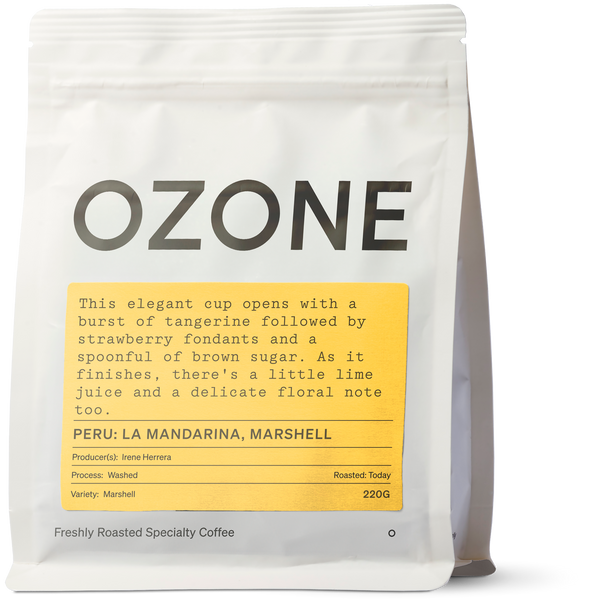
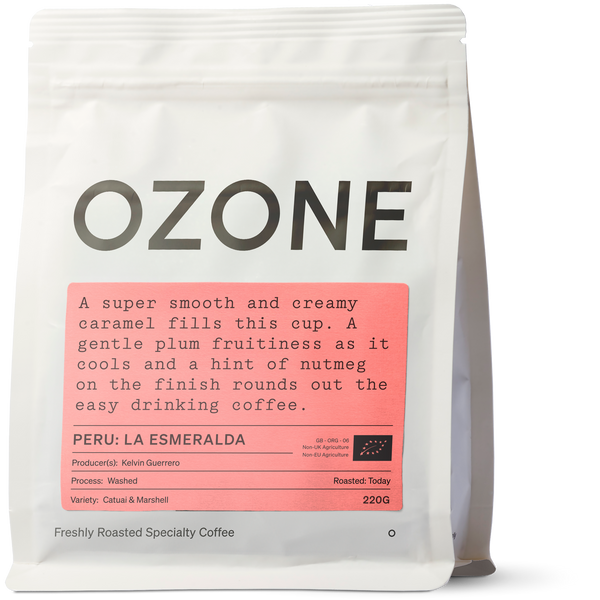
We came to Roiber's coffee through Khipu Coffee, a Peruvian speciality coffee importer founded in 2020 by Mark Russell (a Liverpudlian with Peruvian family), his cousin Gonzalo, and their friend Cesar. Mark handles sourcing and sales from Liverpool while Gonzalo manages logistics from Peru. Most of our Peruvian coffees to date have come from the Cajamarca region, so when Mark came to cup his new harvest with us and two lots from a village and region we'd never sourced from stood out immediately on the table – both from Roiber Becerra – we knew we couldn't pass them up. Tiny lots from a very small farm, from a producer whose work clearly spoke for itself.
Roiber and his family want roasters to taste the depth of intention behind every decision on the farm. From tree layout and varietal zoning to fermentation logistics and drying infrastructure, everything is deliberate. Their goal isn't just to produce beautiful coffee – it's to have that work recognised and tasted in the cup. We think it absolutely is.