Bolivia: La Linda, Caturra, Coco Natural
Fincas Los Rodriguez
-
This coffee is a real sweet treat - leading with lemon & limeade before shifting into raspberry and strawberry candy. A little plum edge develops it as it cools to remind you of the coco natural processing, but it's a very elegant version of a naturally processed coffee.
If you ask Pedro Rodriguez about Finca La Linda he’ll tell you “This is where the dream started”. We think that this coffee is definitely dreamy, so the results match the aspiration! This is the only Bolivian coffee we’ve sourced from Finca La Linda this harvest, a small-batch exceptional quality Coco Natural process Caturra.
The Necessary Shift
La Linda is one of the Fincas Los Rodriguez, run since 2012 by our friends at Agricafe in Bolivia. At a time when many smallholder farmers were abandoning Bolivian coffee altogether, the Rodriguez family made the bold decision to begin farming for themselves. By the early 2010s Bolivian coffee production had gone into freefall - annual exports dropped from roughly 70,000 bags in 2010 to just 22,000 bags by 2019. Facing a nearly overwhelming combination of challenging terrain, lack of infrastructure investment, political instability, and climate change, Pedro, Daniela and Pedro Pablo felt that if coffee production was going to survive in Bolivia, they would need to start farming themselves.
A Shining Example
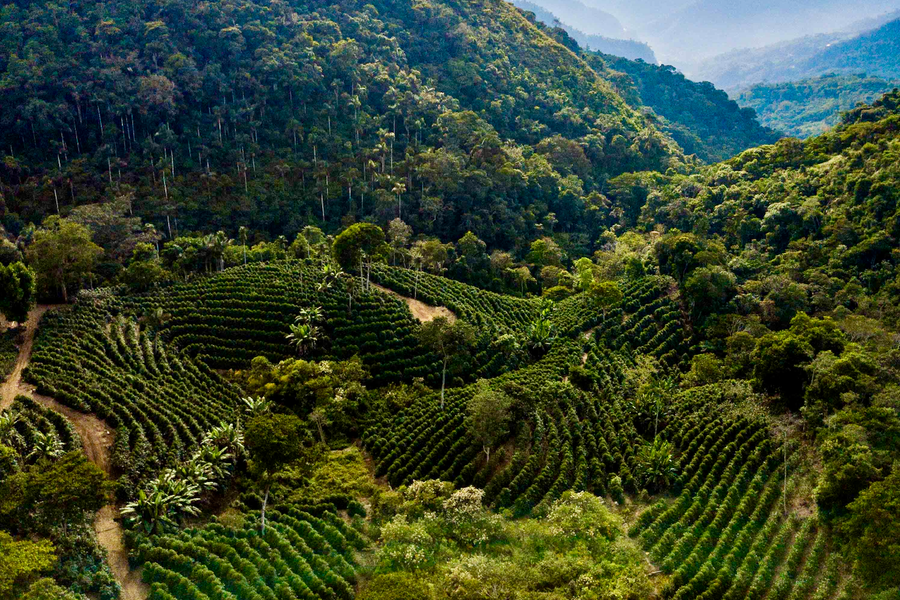
The family acquired land near their Buena Vista mill in Caranavi to establish Finca La Linda. Rather than following traditional farming practices common in the region, they took an extremely methodical, innovative and scientific approach. They consulted leading specialty coffee agronomists from around the world, trialled different varieties and techniques, and carefully documented everything they learned. They also brought in Iván Hugas, an oenologist from the Argentinian wine industry, to guide their approach to fermentation at the wet mill. The exceptionally well controlled processing at Buena Vista is a core component of the high-quality coffee Agricafe are now known for.
La Linda holds a special place in Agricafe’s hearts, as what they learned here helped develop and shape the plans for all their future farms and became the basis of the guidance offered through the Sol De La Mañana program. While the lush eastern region of Los Yungas is traditionally where Bolivian coffee production is concentrated, La Linda and 7 other Rodriguez farms are located in Caranavi, famous for its fertile soils and high altitude. Now growing Caturra, Catuai, SL28, Java, and Bourbon between two mountains coated in dense forest, it is both a peaceful haven and one of Pedro and Daniella’s biggest success stories. The family also made a commitment to growing eco-friendly coffee and championing conservation from the outset, aiming to keep 60% of their land as nature reserves with coffee trees planted as agroforest amongst the native woodland.
Classic Caturra
The coffee we’ve got here is a small lot of Caturra. This is a classic Bolivian coffee varietal for farms here generally, but not one that the Rodriguez family actually grow a lot of volume of themselves. Over time, the focus on their own farms has moved more towards the planting of new coffee varietals. East in the Samaipata region, another farm, Floripondio, hosts the family's varietal nursery - here they've planted over 50 different varieties to determine which ones return the best results in the Bolivian terroir. Caturra is expected to keep a place alongside the more unusual varietals though. It is tried and tested in the Bolivian environment and proven itself as reliable for producing both good yields and a really nice, balanced cup profile.
Processing That’s Worth The Effort
This lot is particularly small in size because processing coffee in the Natural style isn’t common in Bolivia as it presents a number of challenges with the local climate. The Rodriguez family saw the value that Natural processed coffees could bring in terms of diversifying the range of flavours you get (and they know that we customers are very keen!) so they decided to invest both money and effort into creating a way of doing this process which would work in Bolivia. Suitable coffee is chosen by mill manager Adrian Silva when it arrives at the wet mill - he will only attempt Natural processing on certain varietals at the perfect ripeness (measured with both colour and sugar levels) so meticulous control is necessary from the very beginning. The local weather forecasts must also be in alignment for Natural coffees to be successful, needing a guaranteed period without rain when the selected cherries can be reliably laid out on raised beds in the sun.
The freshly picked coffee cherries undergo a short outdoor pre-drying stage, rapidly reducing moisture to prevent defects while preserving the complex carbohydrates in the fruit - the building blocks of flavour. Then the coffee moves to the Coco dryers: static wooden boxes with metal grilles at the base, allowing precise control of airflow and temperature. Every lot is tracked for temperature, pH and microbial activity throughout. These especially stringent conditions, needed to ensure success with naturals, mean that the batches must be small by design, so we’ve only got a very limited amount of this amazing coffee.
-
- Country: Bolivia
- Department: La Paz
- Region: Caranavi
- Farm: La Linda
- Farm size: 10.53 hectares
- Coffee production area: 3.92 hectares
- Producer: Agricafe
- Altitude: 1,400 - 1,450 m.a.s.l.
- Processing Method: Coco Natural
- Varietal: Caturra
- GPS: 15°47'50.0"S 67°32'39.7"W
-
Cupping Notes: Lemon & Lime-ade, strawberry candy, plum.
Cup of Excellence Cupping Scores
- Clean Cup: 7/8
- Sweetness: 7/8
- Acidity: 6.5/8
- Mouthfeel: 6/8
- Flavour: 6.5/8
- Aftertaste: 6/8
- Balance: 6/8
- Overall: 6.5/8
- Correction: +36
- Total: 87.5/100
If you'd like to find out more about how we score coffees, make sure to read our blog post “What Do Coffee Cupping Scores Actually Mean?” and if you'd like to try cupping yourself, we've got a guide to that too! What is Coffee Cupping.
-
Medium dark - Through the gap and let this develop a little in the gap before pushing through to the edge of second as the roast finishes.
-
-
Producer Stories
Learn more about coffee sourcingFincas Los Rodriguez
Fincas Los Rodríguez is a family-run coffee project led by Pedro and Daniela Rodriguez, focused on producing high-quality, traceable coffees across twelve farms in Bolivia’s Caranavi and Samaipata regions.
Read more