-
This is In My Mug coffee number 934, roasted and posted to subscribers on Friday 2nd October 2026.
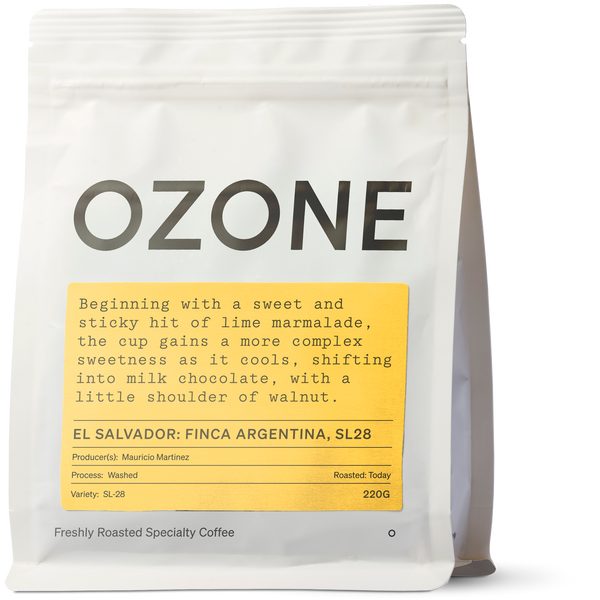
A sweet, sticky hit of lime marmalade opens the cup. As it cools, that sweetness gets more complex and shifts into milk chocolate, with a gentle shoulder of walnut arriving on the finish.
This week we're back with the Martinez family at Finca Argentina for the third time this year, but this one comes with a rarity attached. It's SL28, and it's the first fully separated lot of this varietal we've had in your mug for some time.
A tree with a number
Every SL28 tree alive today traces back to a single tree selected in 1935. The story starts a few years earlier, in 1931, when A.D. Trench, senior coffee officer at the Scott Agricultural Laboratories near Nairobi, went looking for coffee that could survive somewhere difficult. Travelling through Tanganyika, now Tanzania, he found trees in the Monduli district that seemed to shrug off drought, disease and pests better than anything else he'd seen. He collected seed and brought it back to Kenya, where testing confirmed what he suspected: this population, which became known as Tanganyika Drought Resistant, really was tougher than the rest.
Between 1935 and 1939, researchers at Scott Labs worked through dozens of individual trees from different populations, evaluating each for yield, cup quality, drought tolerance and disease resistance. Every selection worth keeping got an "SL" number. SL28 was pulled from within the Tanganyika Drought Resistant population in 1935, and went on to be considered the prize selection of that period of intensive breeding.
What makes SL28 worth all this fuss is what happens in the cup. At altitude, it's capable of intense blackcurrant and dark berry character, layered with citrus, red fruit and a body that can turn genuinely wine-like. It asks a lot of the land and the farmer growing it, but when those conditions line up, few varietals reward the effort as generously.
Read our full guide to the SL28 varietal →
Kenyan roots, Salvadoran soil
SL28 has travelled a long way from Kabete. World Coffee Research lists it as common across Kenya, Malawi, Uganda and Zimbabwe, and it's also found homes in Latin America: Colombia, Guatemala, Costa Rica, Peru, Panama, and here at Finca Argentina in El Salvador.
The Martinez family planted a small amount of SL28 on their Guachipelin tablón back in 2016, alongside Centroamericano H1, Yellow Bourbon and Icatu. It's a tiny planting compared with the rest of the farm, which is exactly why a fully separated lot like this one doesn't come around often. Roland was out at the farm in February, cupping through the season's lots with Mauricio at the Los Ausoles mill, and this Washed SL28 stood out enough that we bought both this and the Natural version on offer.
Grown on Finca Argentina's volcanic soils in El Salvador's Cordillera de Apaneca-Ilamatepec, this SL28 carries the acidity and fruit character the varietal is known for, but with its own accent, shaped by the same terrain that gives the farm's other coffees their character.
Why this one stands out
Much of the SL28 that reaches specialty roasters comes from Kenya, where it's often not sold as a single variety at all. Smallholder farmers deliver cherry to shared washing stations, and the coffee that comes out the other end can be a mix - SL28 alongside SL34, Ruiru 11 and Batian, graded afterwards by bean size rather than variety. Our own Kiriga Estate coffees follow that pattern: excellent coffee, but a blend of SL28 and SL34 rather than one or the other.
What Finca Argentina offers is different. A small, deliberately separated planting, grown by a single family who know exactly which trees are which, on a farm on the other side of the world from where the variety originated. It's a chance to taste SL28 on its own terms, grown somewhere its breeders in 1930s Kenya never imagined it would end up.
Eighteen years, three coffees
We've been buying from the Martinez family since 2008, and this year alone that relationship has given us three genuinely different coffees: the Centroamericano H1 from Guachipelin back in August, the Yellow Pacamara from the family's own San Jorge plot, and now this SL28. That range is the real reward of a relationship this long. Eighteen years in, we know this farm well enough to explore it properly, tablón by tablón, varietal by varietal.
The family keep experimenting, too. Alongside the established plots, they've been trialling newer varieties including Portillo and, since 2023, Mundo Novo, a Bourbon x Typica cross that's well known in Brazil but rare in Central America. Its first harvest is expected in 2026. It's the sort of experimenting that usually turns into next year's new lot.
Read the full Martinez family producer story →
In the cup
Beginning with a sweet and sticky hit of lime marmalade, the cup gains a more complex sweetness as it cools, shifting into milk chocolate, with a little shoulder of walnut.
Traceability
- Country: El Salvador
- Department: Ahuachapán
- Municipality: Ahuachapán
- Nearest town: Turín
- Mountain Range: Cordillera de Apaneca-Ilamatepec
- Farm: Finca Argentina
- Producer: The Martinez Family
- Dry mill: Los Ausoles
- Elevation: 1,300 m.a.s.l.
- Variety: SL28
- Processing method: Washed
- Relationship since: 2008
Cupping scores
Cupping notes: Lime marmalade, milk chocolate, walnut.
- Clean Cup: 6/8
- Sweetness: 6.5/8
- Acidity: 6.5/8
- Mouthfeel: 6.5/8
- Flavour: 6.5/8
- Aftertaste: 6.5/8
- Balance: 6.5/8
- Overall: 6/8
- Correction: +36
- Total: 87/100
If you'd like to find out more about how we score coffees, have a read of What Do Coffee Cupping Scores Actually Mean? And if you fancy trying cupping yourself, we've got a guide to that too: What is Coffee Cupping.
Roasting information
Medium Dark. Give this coffee a confident push through first and into the gap, right up to the edge of second before you drop.
934 - El Salvador: Finca Argentina, SL28, Washed

Finca Argentina is owned and operated by Mauricio Martinez, father of our dear friend Alé, and we’ve been sourcing coffee from Finca Argentina since 2008.
Get the coffee