-
This is In My Mug coffee number 930, roasted and posted to subscribers on Friday 4th September 2026.
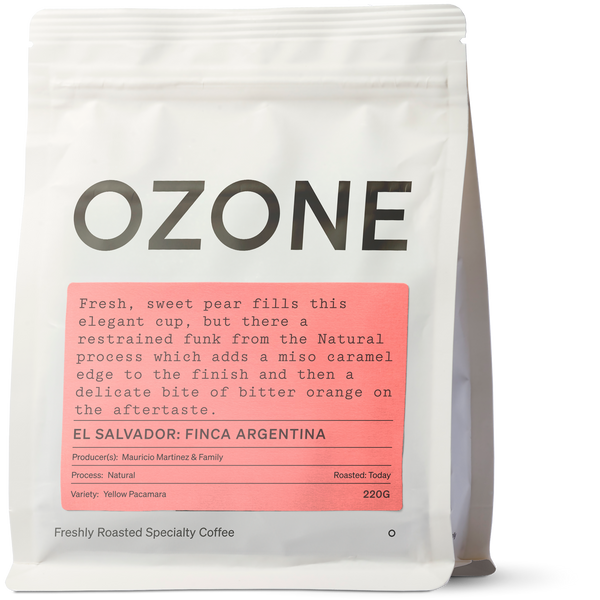
Fresh, sweet pear fills this elegant cup, but there a restrained funk from the natural process which adds a miso caramel edge to the finish and then a delicate bite of bitter orange on the aftertaste.
Alejandro Martinez's grandfather once owned more than 250 manzanas of coffee farms across El Salvador, getting on for 180 hectares. With that much ground to choose from, he could have kept back coffee from wherever he liked. He chose two hilly hectares at the top of one particular farm, steep enough that picking it properly takes real effort, and had that set aside for his own cup. Everything else was for selling.
That plot is called San Jorge. This week, it and the tablones around its upper edges are growing something his grandfather never saw.
The plot he kept for himself
San Jorge sits at the highest point of Finca Argentina, near the town of Turin in Ahuachapán, El Salvador. Just over two hectares, three manzanas, between 1,300 and 1,350 metres. The ground is hilly enough to make it properly difficult to work. On most farms, that's the plot that gets neglected. Here, it was reserved.
Historically, this is where the farm's Owner's Selection came from. Alejandro's grandfather, Luis Guillermo Martinez, bought Finca Argentina in 1967 and quickly made it his favourite among the estates he owned. Somewhere along the way, San Jorge became the plot he drank from personally. Of everything on offer, he picked the two hardest hectares to farm. Make of that what you will about where the good coffee actually comes from.
The soil got a boost of its own in 2005, when the Santa Ana volcano erupted and covered the region in ash. Plenty of farms lost up to two years of production to it. What grew back afterwards grew back in ground that had just been handed a fresh delivery of minerals, and the coffees here have been better for it ever since.
We've bought from the Martinez family every year since 2008, after Alejandro, Alé to everyone who knows him, sent samples to European roasters while helping his father Mauricio work out what to do with an estate that had underperformed for years. One of those samples landed with us. Eighteen consecutive harvests later, San Jorge is the plot we look forward to most.
Both Alé and Mauricio live in Canada these days. Mauricio still owns and oversees Finca Argentina remotely, relying on his farm manager and the team on site for the day-to-day, and he's back in El Salvador regularly to check in.
Read the full Martinez family producer story →
A gift from Nicaragua
What's growing there now, mostly on San Jorge and spreading into the upper reaches of the tablones next to it, is Yellow Pacamara. It got there by way of a security guard in Nicaragua.
Around 2004, that guard was walking the Red Pacamara field at El Limoncillo, the Mierisch family's farm in Matagalpa. A few of the trees were carrying yellow fruit instead of red. He mentioned it to the farm manager and was, initially, ignored. Erwin Mierisch's father took more interest, though mostly because he suspected the trees were sick, and sent the question to the Salvadoran coffee council, Pacamara being a Salvadoran invention. The answer came back: not a disease. A natural mutation of Red Pacamara. Which was strange, because there wasn't a single yellow-fruiting variety anywhere on Limoncillo at the time. It hadn't blown in from a neighbouring plot. It had simply happened.
The Mierisch family fenced off the trees, kept the seed separate, and began the long business of growing it out. Years later, that same seed travelled from Nicaragua to San Jorge. That part was us. We buy from both families, we've spent years introducing one to the other, and a friendship between two producers on opposite sides of the region grew out of two people we happen to like a great deal. Every so often the job is less about buying coffee and more about making sure the right people end up talking to each other.
One in ten
Pacamara was difficult before anyone made it yellow. It was crossed at the Salvadoran Institute for Coffee Research in 1958 from Pacas and Maragogype, and it took more than three decades of selection to stabilise into something that reliably came true from seed.
The yellow version adds a fresh set of problems. It wants roughly 20% more fertiliser than a Bourbon or a Caturra, and soil with plenty of magnesium, zinc and potassium in it. It's susceptible to more or less every major disease going. It yields poorly. And around nine out of ten seedlings revert to red, so expanding a plot means raising far more plants than you need and culling most of them once they fruit. Four years per generation, and you don't find out whether it worked until the end.
Nobody plants this because it's sensible. The family put it on the plot they'd always kept back for themselves, and let it spread from there. That's a decision.
Our full guide to the Pacamara varietal →
When is yellow ripe?
Cherry colour comes down to pigment. Red fruit gets its colour from anthocyanins. Turn that pathway down and the carotenoids underneath become visible instead, so the fruit ripens yellow.
The practical consequence is what makes this coffee expensive. A red cherry broadcasts its readiness: green, then a flush of orange, then unmistakable red, legible from a metre away by someone moving quickly. A yellow cherry goes green, then pale yellow, then a marginally deeper yellow. Green to pale yellow is precisely the window where the sugars haven't arrived yet, and it's the hardest gap to see.
On San Jorge and the ground around it, that judgement call is made harder still by the hill itself. Steep ground slows picking down regardless of variety. Add a cherry that won't tell you plainly when it's ready, and you need pickers who know these specific plots, not just this specific coffee.
That's a harder ask than it sounds. El Salvador needs somewhere north of 150,000 harvest workers to bring its crop in and hasn't had that number for years. Younger workers have gone to construction and manufacturing in the cities, or to the United States, and harvests across the region are increasingly brought in by older workers and by women. Farms are competing for the people who know what they're doing, and this ground asks more of them than most plots do.
On a washed coffee, a few underripes can be caught later at the wet mill. On a natural, where the fruit stays wrapped around the bean through the entire drying process, whatever goes on the bed is what ends up in the bag.
Dried in its own fruit
Finca Argentina's washed lots travel down to the Los Ausoles dry mill. The naturals never leave the farm.
Natural processing means the whole cherry goes out to dry with the bean still inside it, shrivelling down like a raisin over a couple of weeks while the fruit's sugars work inward. Pacamara beans are enormous, which makes all of this slower. Push the drying and the outside goes while the middle stays damp. Let it drag and you get problems of a different kind. It's turning, raking and watching, every day, until it's done.
How natural processing works →
Roland cupped this lot alongside the farm's Centroamericano H1 back in February, on the same visit to Los Ausoles with Mauricio. Different plot, different variety, same table. It made the cut just as easily.
Traceability
- Country: El Salvador
- Department: Ahuachapán
- Nearest town: Turín
- Mountain Range: Cordillera de Apaneca-Ilamatepec
- Farm: Finca Argentina
- Plot: San Jorge
- Producer: The Martinez Family
- Farm size: 35 hectares
- Elevation: 1,300 to 1,350 m.a.s.l.
- Variety: Yellow Pacamara
- Processing method: Natural
- Dry mill: Los Ausoles
- Relationship since: 2008
Cupping scores
Cupping notes: Pear, miso caramel, bitter orange.
Cup of Excellence Cupping Scores
- Clean Cup: 7/8
- Sweetness: 6.5/8
- Acidity: 6/8
- Mouthfeel: 6/8
- Flavour: 6.5/8
- Aftertaste: 6/8
- Balance: 6.5/8
- Overall: 6.5/8
- Correction: +36
- Total: 87/100
If you'd like to find out more about how we score coffees, have a read of What Do Coffee Cupping Scores Actually Mean?, and if you fancy trying cupping yourself, we've got a guide to that too: What is Coffee Cupping.
Roasting information
Medium - this coffee is taken through the gap between cracks and allowed to develop a little, during this time we're paying close attention to the heat and dropping the roast well before second crack.
930 - El Salvador: Finca Argentina, Yellow Pacamara, Natural

Owned and operated by Mauricio Martinez and his family, we've been sourcing this El Salvadoran coffee for well over a decade from Finca Argentina. They consistently produce delicious and environmentally friendly specialty coffee, while giving back to their local community.
Get the coffee